To get book recommendations from an AI agent that fit you, give the agent your actual reading history first: sync your Kindle library and highlights, import your Goodreads shelves, and let it see what you have been reading online. Once your agent has that shelf, "what should I read next?" returns titles you have not read, with a one-line reason tied to books you loved. The whole setup takes about ten minutes with a Fasrad agent and the free Scanner browser extension.
How to get book recommendations from an AI agent that knows what you read
Store recommendation engines know what you bought. Your own agent can know what you finished, what you highlighted, and what is already on your want-to-read shelf. Here is the setup, in five steps.
Fasrad · September 16, 2026 · 5 min read
Why generic book recommendations miss
Amazon recommends what sells next to what you bought, including the gifts and the textbooks. Goodreads recommends what its crowd rated highly. Neither knows that you abandoned two of your last five thrillers, that you highlighted thirty passages of one finance book and none of the next, or that a novel has been sitting on your want-to-read shelf since July.
An agent with your shelf can. The difference is not a smarter model. It is a model that has your data in front of it when you ask.
Step 1: Install the Scanner extension
The Fasrad Scanner is a browser extension for Chrome, Edge, and Firefox. It is the bridge between the websites that hold your reading history and your agent. Install it, sign in with your Fasrad account, and pick the agent it should feed. That is the only setup the extension needs.
Step 2: Sync your Kindle library and highlights
Open the Kindle cloud reader at read.amazon.com while signed in to Amazon, click the Scanner icon, and open the Kindle tab. One click on Sync from Amazon pulls two things into your agent: every book you own on Kindle, and every highlight you have made, book by book.
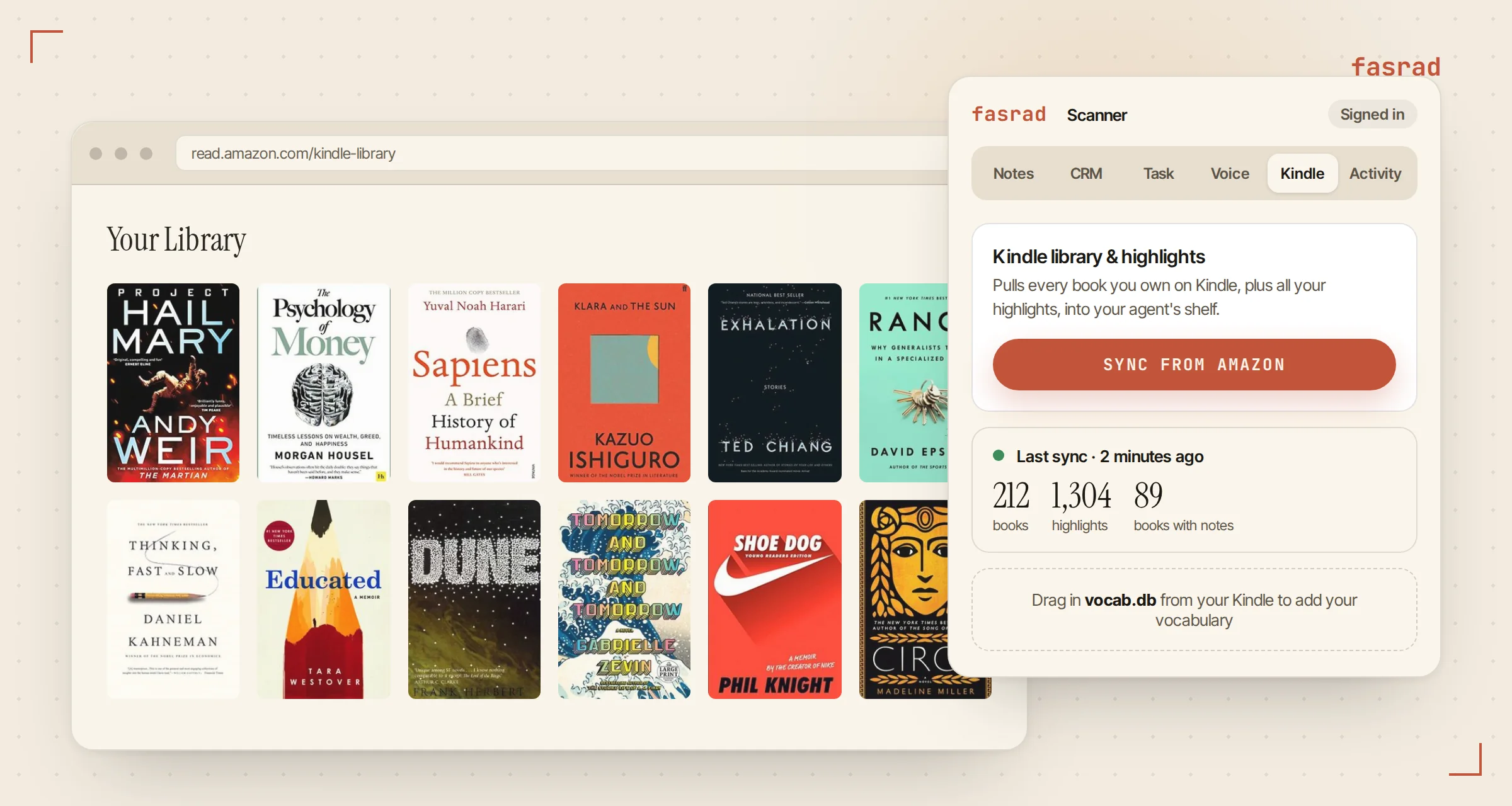
Your agent files each book on a shelf with its cover, author, and subjects, and keeps the highlights in a notebook per book, the same notes that make it a second brain for everything else you clip. If you use Kindle's Vocabulary Builder, drag the vocab.db file from your device into the same tab and the words you looked up come along too. We will use those in step 5.
Step 3: Import your Goodreads shelves
Goodreads is where most readers keep the list that matters most for recommendations: the want-to-read shelf. Open any page on goodreads.com, click the Scanner icon, and open the Task tab. You will see Import Goodreads shelf with a picker for Read, Want to Read, Currently Reading, and any custom shelves you have made.
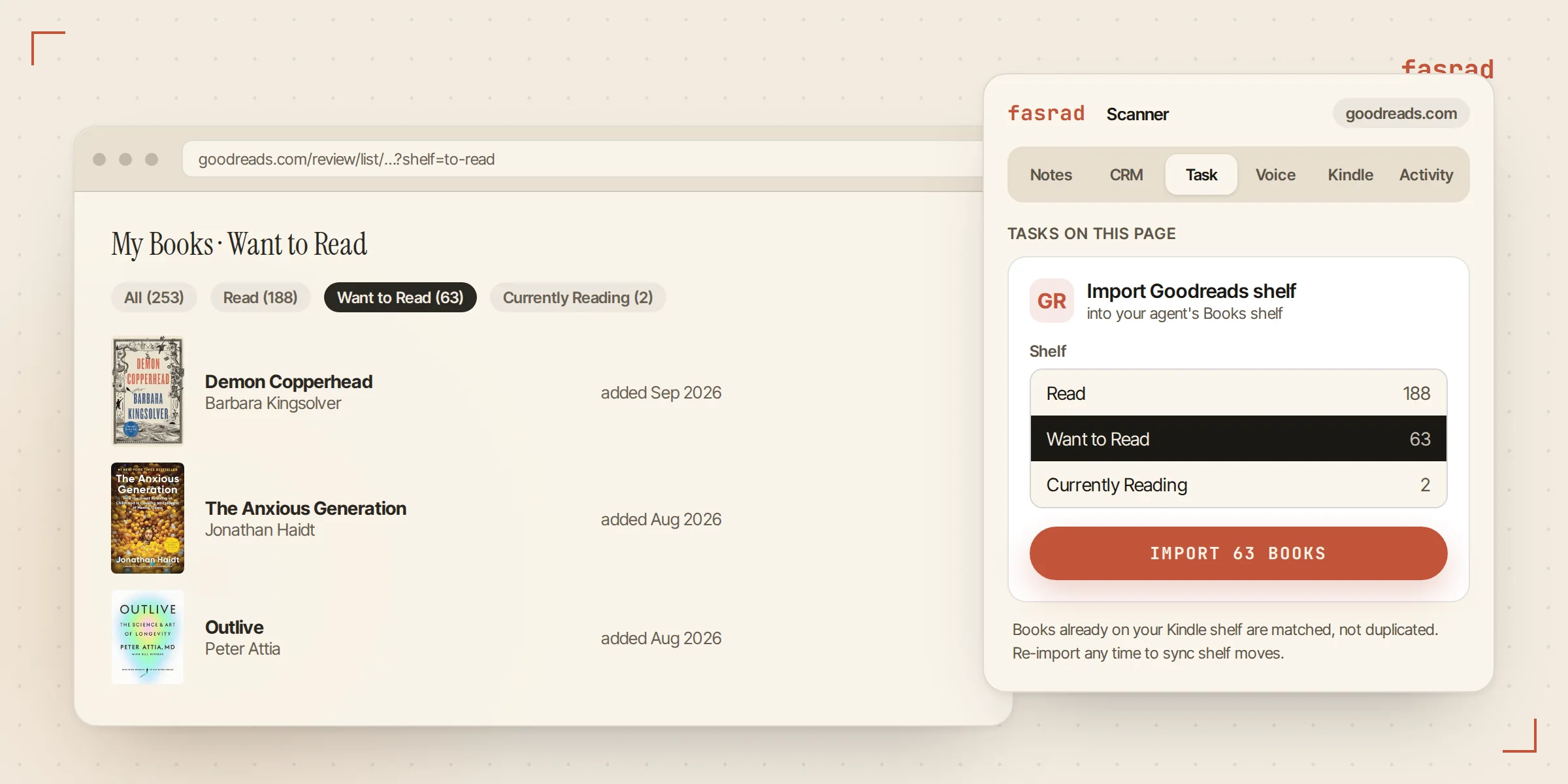
Import Read and Want to Read both. Books that are already on your Kindle shelf are matched by ISBN or title rather than duplicated, and a Kindle book that Goodreads says you have not read yet stays marked as unread. Your ratings and read dates come across as well. Re-run the import whenever you move books between shelves.
Step 4: Ask your agent what to read next
Now open your agent in the web app or on Telegram and ask. A few prompts that work well:
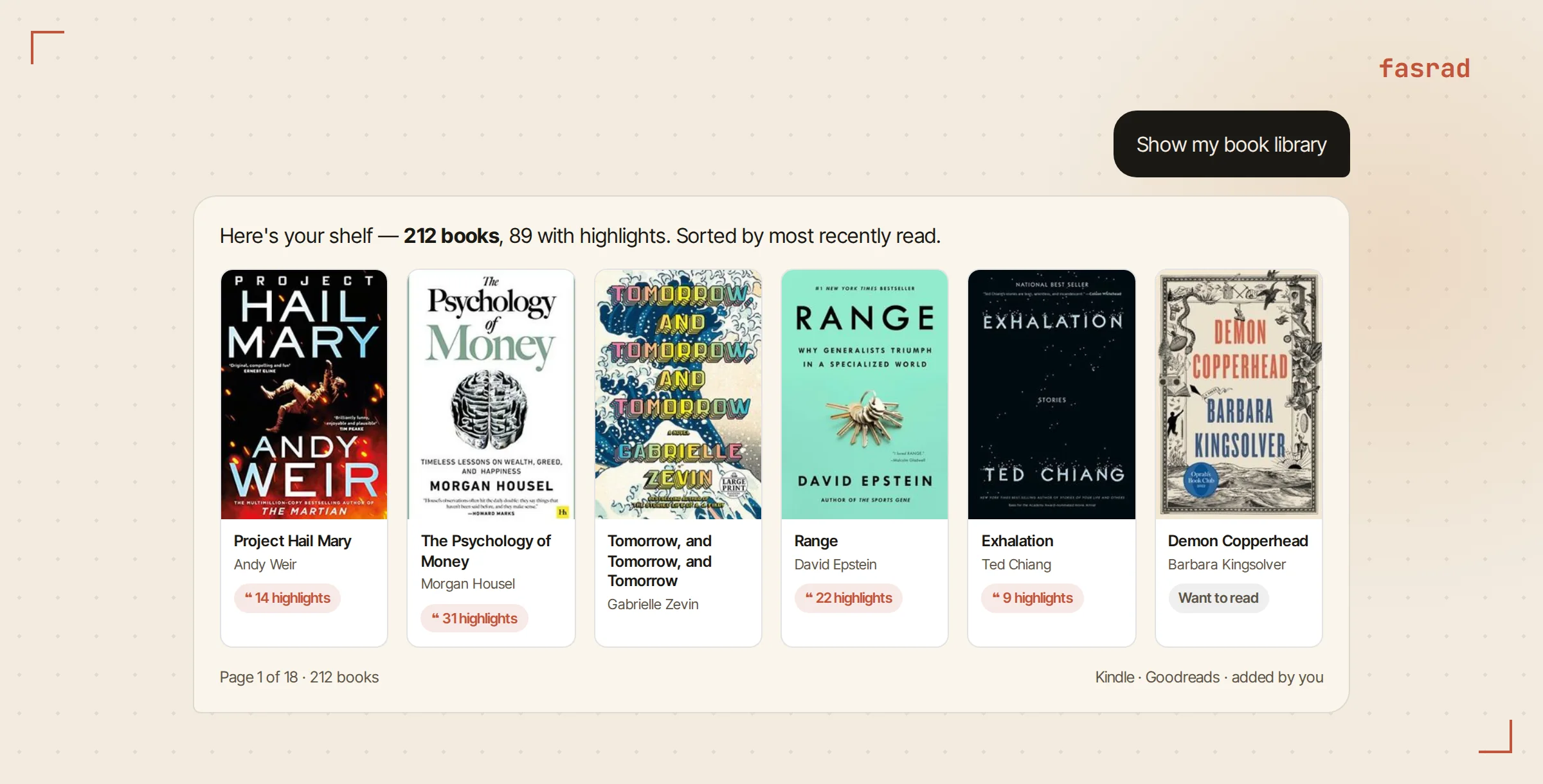
- "Show my book library" renders your whole shelf as cover cards. Books with highlights show a count; click one and the highlights open in a reader.
- "Have I read anything by Madeline Miller?" checks your shelf instead of guessing.
- "Which books about habits have I read?" searches subjects, descriptions, and even your highlight text.
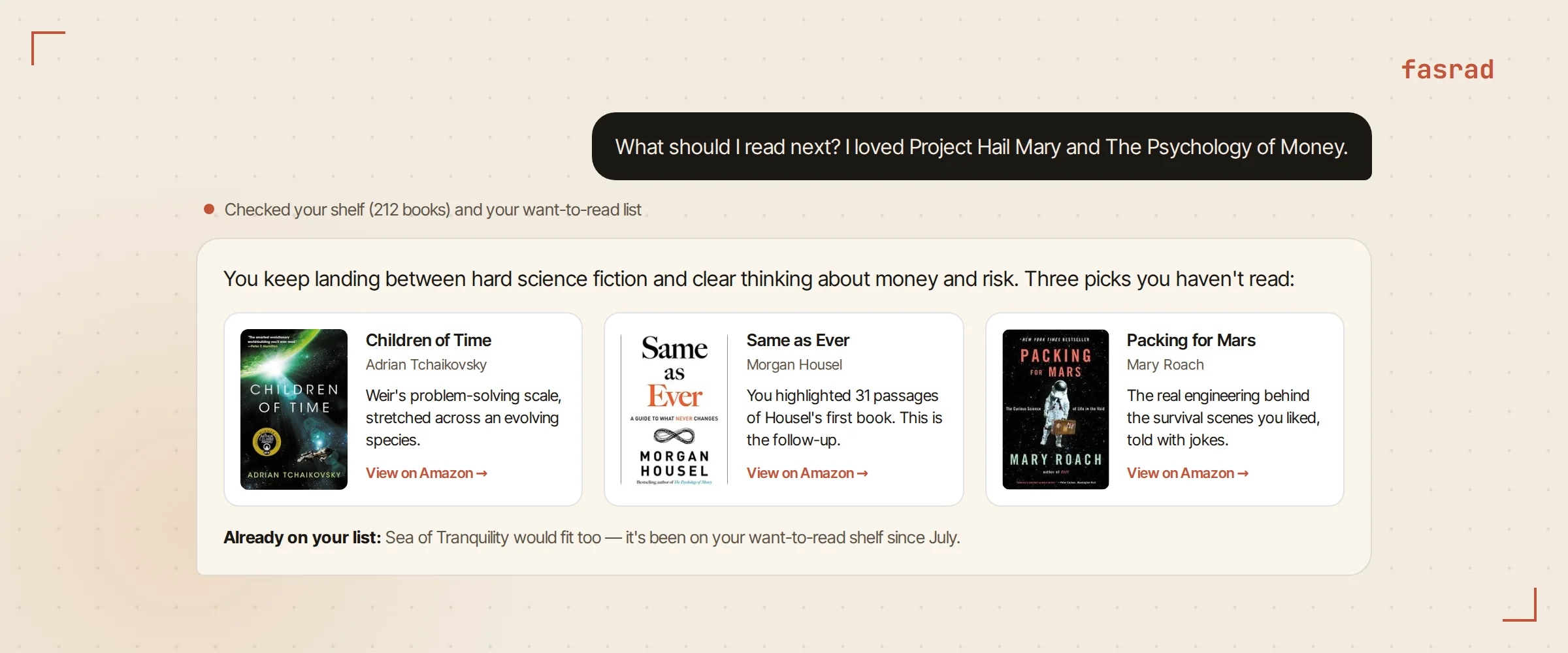
- "What should I read next? I loved Project Hail Mary and The Psychology of Money." is the one you came for.
For a recommendation request, the agent reads your shelf, your highlights, and your want-to-read list before it answers. It suggests books you have not read, explains each pick in one line that points back to something you actually finished, and links every title to Amazon. If a suggestion is already on your Goodreads list, it says so instead of presenting it as a discovery.
You can steer it the way you would steer a friend who works in a bookstore. "Something shorter." "Nonfiction only." "More like the science, less like the jokes." "What story do my highlights of Range tell?" The agent remembers the answers, so the next round starts from what you said last time.
Step 5: Make it proactive
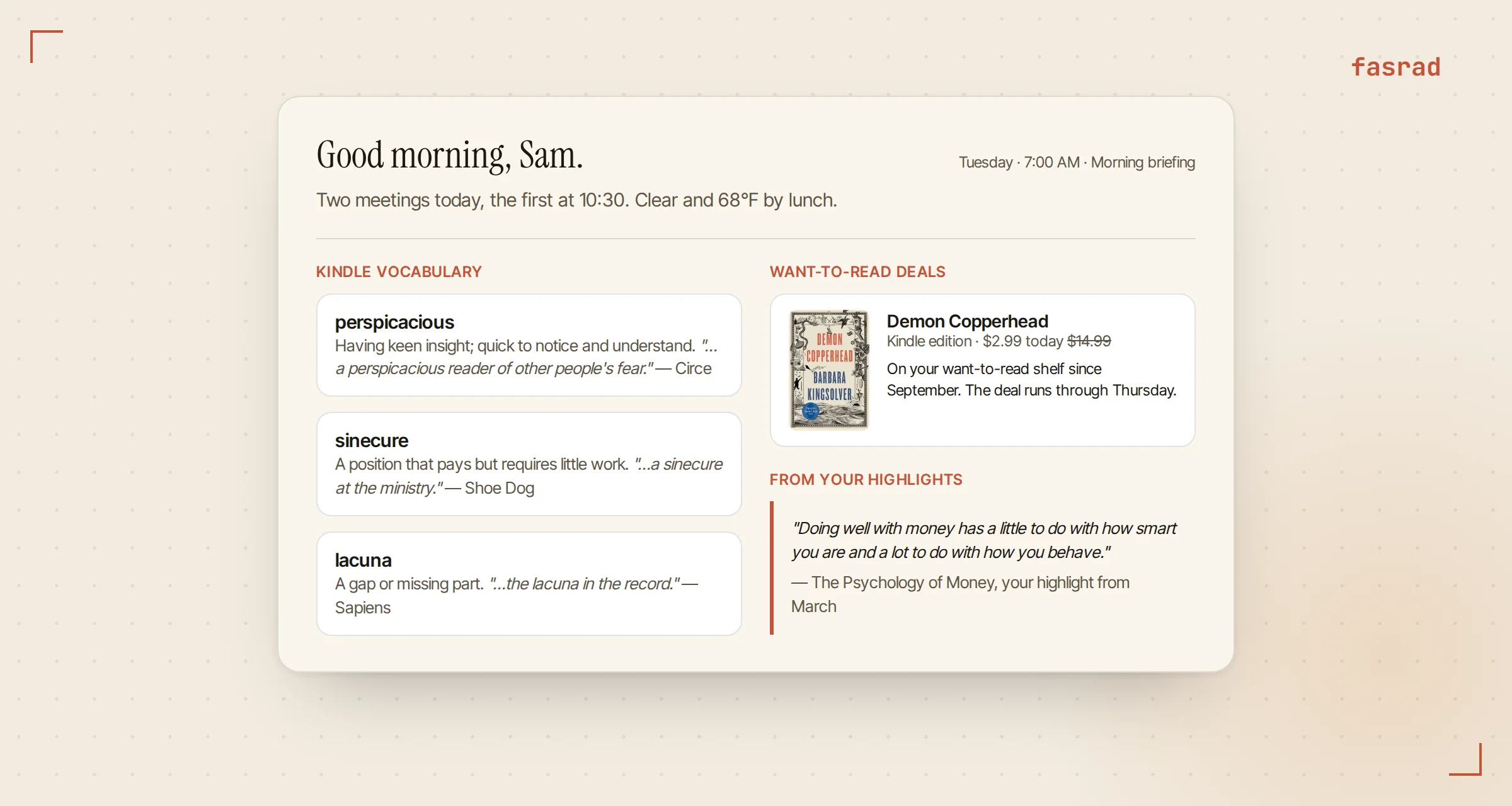
A recommendation you have to ask for is only half the job. Your agent is also a personal assistant with a morning briefing and a scheduler, so three things are worth setting up once, in plain English:
- Vocabulary in your morning briefing. "Include three random words from my Kindle vocabulary in my daily briefing, with a short definition and the sentence I found them in." Your agent remembers the preference and does it every morning.
- Deals on your want-to-read shelf. "Every Friday, check Amazon for price drops on my want-to-read list and tell me if anything is under five dollars." That becomes a scheduled task the agent runs on its own.
- A quote from your own highlights. "Open my briefing with one highlight from a book I read this year." It is your reading, surfaced back to you.
What your agent can see, and what it cannot
The Scanner only sends what you sync or import: your Kindle library, your highlights, and the Goodreads shelves you pick. It can also keep a private record of pages you visit and things you search for, so your agent can factor in what you have been reading online this week. That history stays in your account, sensitive pages are excluded before anything is stored, and a Forget browsing history button in the extension clears it. Your agent has your shelf. Amazon and Goodreads do not have your agent.
Start with the shelf you already have
Most people have years of reading data scattered across a Kindle and a Goodreads account and never get anything back from it. Ten minutes of setup turns that into an agent that knows your taste better than any storefront, tells you what to read next with a reason, and keeps working in the background. Sync the shelf, import the lists, and ask.
Frequently asked questions
Do I need a Kindle to use this?
No. You can import Goodreads shelves alone, or tell your agent about books you have read in chat ("I just finished Circe") and it adds them to the shelf. Kindle sync adds the highlights and the owned-library data automatically.
Does the agent recommend books I already own or have read?
No. Recommendations exclude everything on your read shelf. If a suggestion is already on your Goodreads want-to-read list, the agent tells you it is on your list rather than presenting it as new.
What happens to my highlights?
Each book gets its own notebook of highlights in your agent's Notes, with the Kindle location. You can ask questions across them ("what story do my highlights of Sapiens tell?"), have one appear in your morning briefing, or open them from the book card in chat.
Can I use it on my phone?
Yes. The sync and import steps run in a desktop browser through the Scanner extension. Asking for recommendations works anywhere your agent does: the web app or your agent's private Telegram bot.
Is my browsing history sent to Amazon or Goodreads?
No. The Scanner reads your data from those sites into your own Fasrad account. Nothing goes the other way. Sensitive pages are filtered out before storage, and you can clear the history from the extension at any time.