An AI chief of staff runs your trips by working from what you already have: the confirmation emails in your inbox, the dates on your calendar, and what it remembers about how you like to travel. Connect your inbox to a Fasrad agent, and the flights and hotel land on your calendar on their own. Ask for an itinerary and you get an interactive one you can change by chatting. Ask what a taxi from the airport costs, or where to get coffee near the hotel, and the answer already knows which airport and which hotel. Below is one trip, Austin to Lisbon for a week, handled that way.
How to let an AI chief of staff run your trips
Booking the trip takes twenty minutes. Everything around it, the calendar entries, the itinerary, the airport transfer, the café near the hotel, takes days of small decisions. Here is how to hand all of that to an agent that reads your email and knows your calendar.
Fasrad · September 16, 2026 · 5 min read
Six weeks out: the bookings
Elena books the way most people do: a flight on the airline's site, a hotel through the hotel, and a confirmation email for each. Her agent watches her own inbox, read-only, and she gave it one standing rule months ago: "Put confirmed flights, hotels, and restaurant reservations in my calendar." The United confirmation for AUS to LIS becomes a calendar entry with the departure and arrival in their own time zones, the confirmation code, the seat, and the terminal in the description. The hotel confirmation becomes a stay from check-in to check-out, with the full address and the booking number, which is what makes every later question about "the hotel" work without an address.
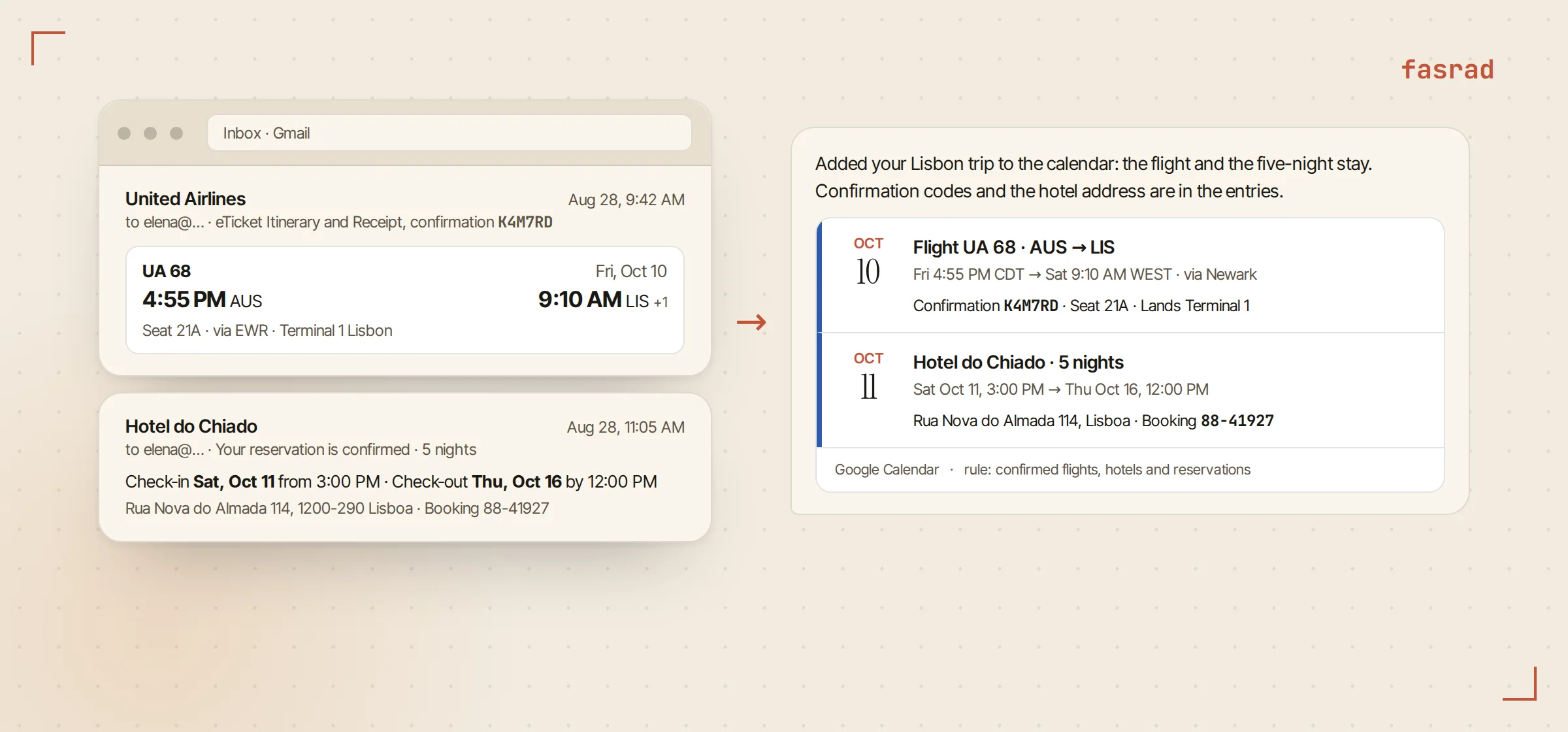
The agent sends a two-sentence note each time it adds something, so there is no surprise entry to discover later. Nothing in the inbox is marked read, moved, or answered. If a booking changes, the new email updates the entry rather than creating a second one. The AI email assistant page covers the rules in more depth, including the ask-first mode for invitations you did not book yourself.
Two weeks out: the itinerary
With the dates and the hotel on the calendar, the itinerary is one request: "Create a sightseeing itinerary for my first three days in Lisbon, all by public transport, with a good cocktail bar for each evening. Make it an interactive widget." The agent checks the forecast for those dates, reads up on the metro and the trams, and builds a widget that renders inside the chat: a header with the dates, a three-day weather strip, one tab per day with timed stops and the transit line for each leg, photo tiles for the main sights, an evening section with the bars and a directions link for each, and a footer that says which timetables to double-check before travel.
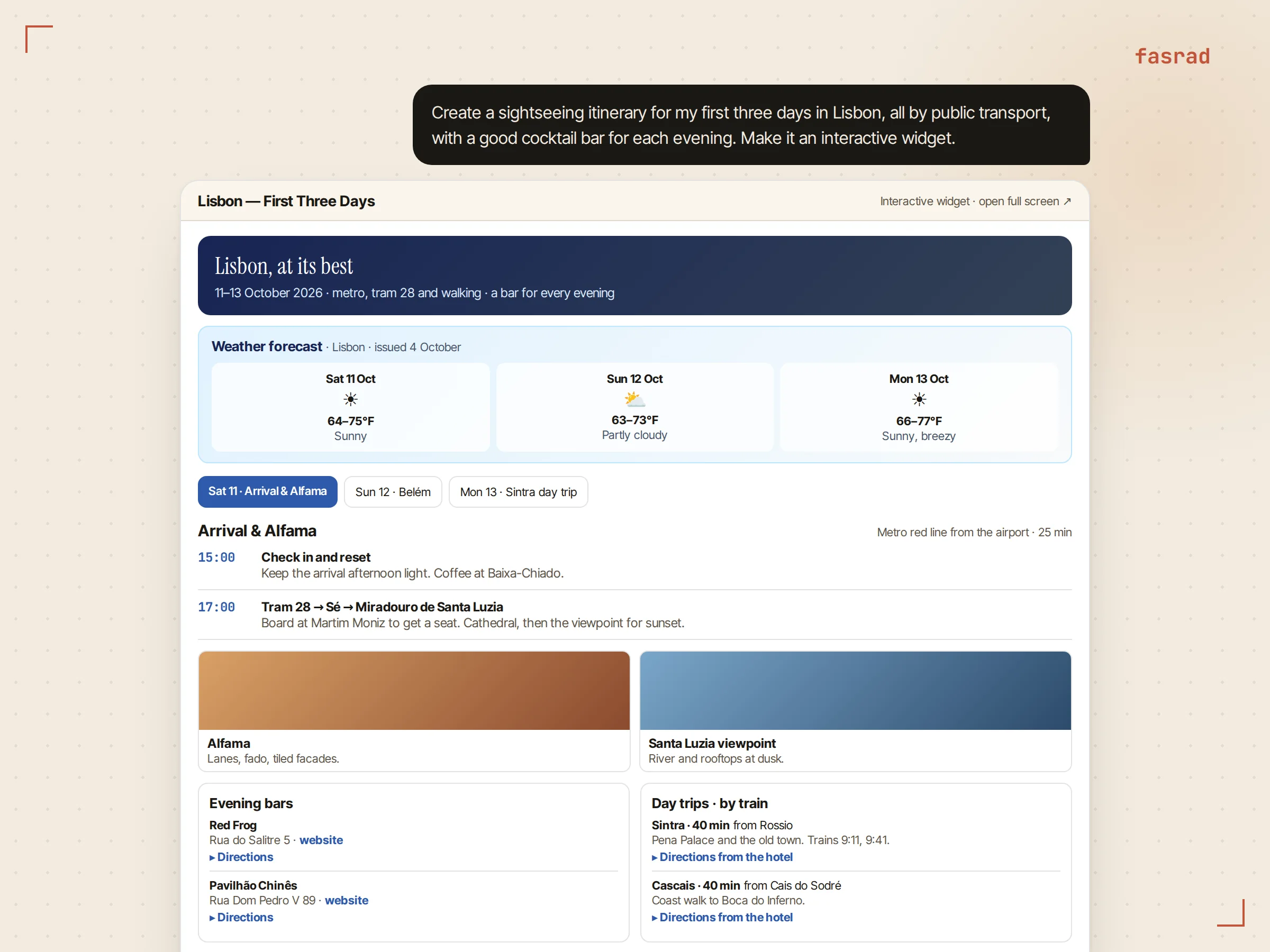
The widget is a page the agent wrote for her, so it can be changed the way a document is changed: by saying what is wrong with it. That matters more than the first version, because the first version is never the one you travel with.
The week before: the changes
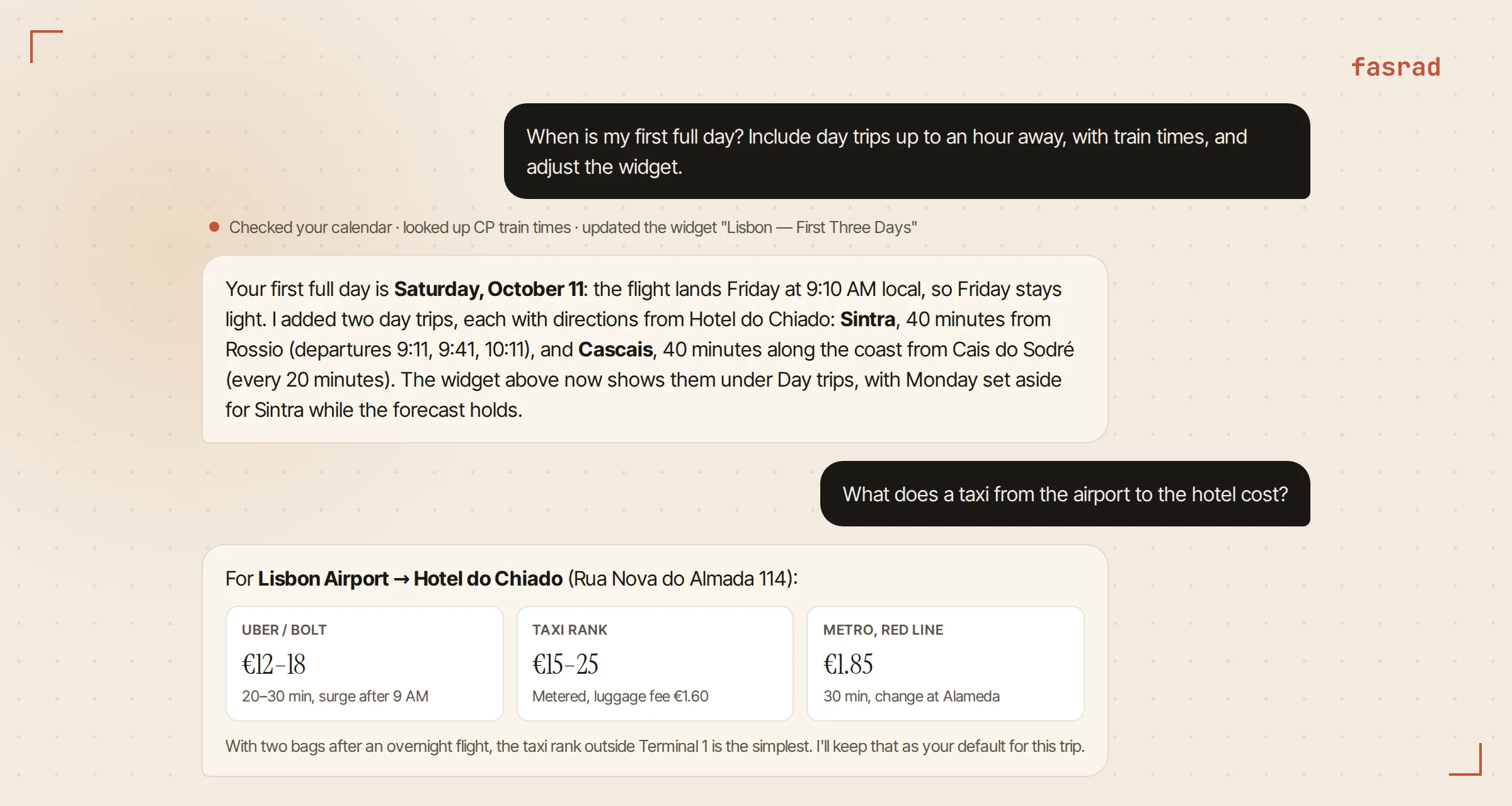
Elena's next message is three questions in one: "When is my first full day? Include day trips up to an hour away, with train times, and adjust the widget." The agent answers from the calendar (Saturday, since the flight lands Friday afternoon), looks up the trains, and replaces the widget in place: Sintra at forty minutes from Rossio with the morning departures listed, Cascais at forty minutes along the coast, each with directions from the hotel. The old version does not linger; the same card in the chat now shows the new plan.
Then the practical one: "What does a taxi from the airport to the hotel cost?" No airport named, no hotel named. The agent reads both off the calendar and comes back with the ride-hailing range, the taxi-rank range, the metro alternative with its price and time, and a one-line recommendation for someone with luggage. A personal assistant that has the calendar does not need the question spelled out.
On the ground: the small questions
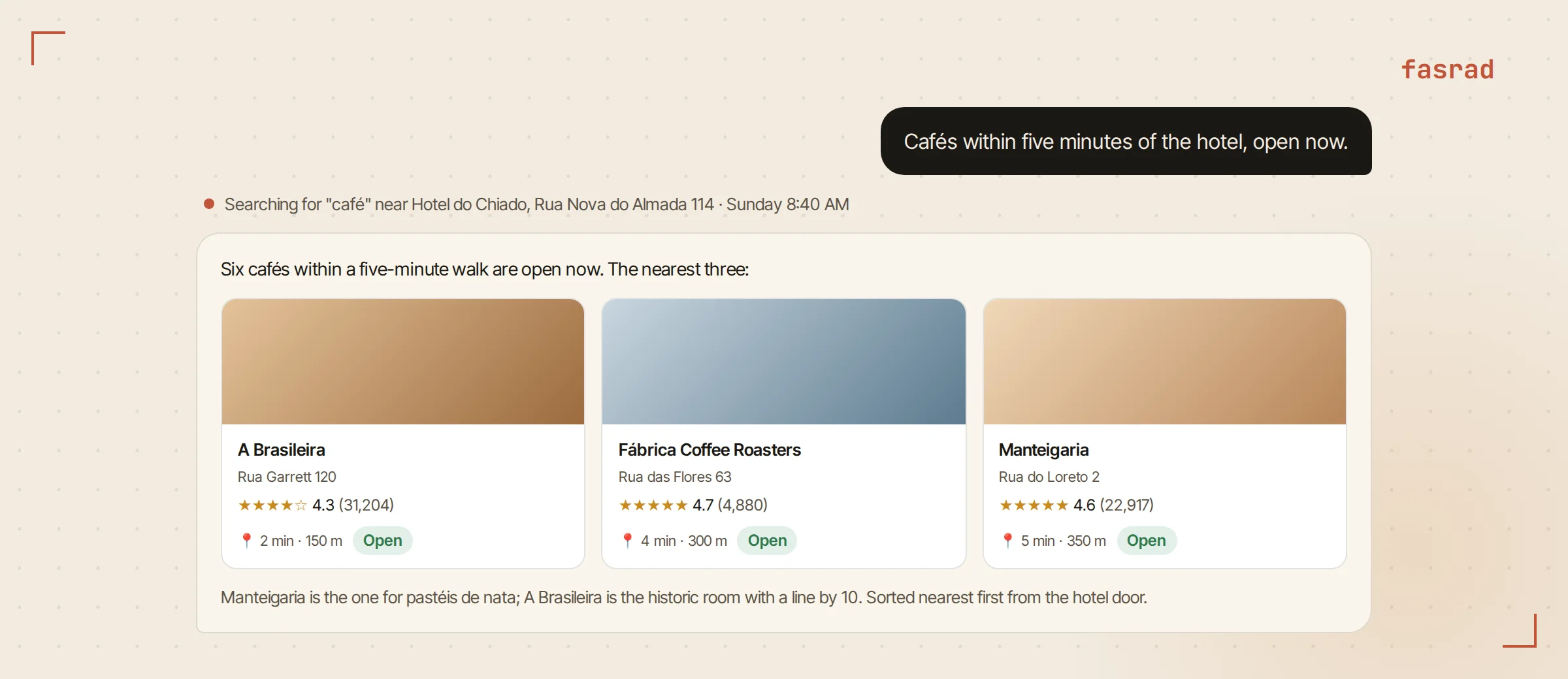
The questions that fill a trip are small and frequent. "Cafés within five minutes of the hotel, open now." The agent searches live business listings around the hotel's address and returns cards: name, street, rating, distance on foot, and whether it is open at this minute, sorted nearest first. "Somewhere for dinner tonight near the second bar on the widget" works the same way, because the widget and the calendar are both things the agent can read back.
For landmarks rather than businesses, the same agent draws on a different source and tells you what a place is before you walk to it. For directions it uses your position when you share it and the hotel when you do not. The AI travel planner page shows the on-the-ground side in detail.
After: what it keeps
A chief of staff is useful because the second trip is easier than the first. The agent remembers that she prefers the taxi rank with luggage, that she wants the first evening light, and that a forty-minute day trip is her limit. Those become defaults the next time a flight confirmation arrives. A few days after she is home, it asks how the trip went, and the answer, "the Sintra day was the best part, do that again," is filed for the next one.
What a chief of staff does differently
A travel app holds what you type into it. A chief of staff already has the context and brings it to every question:
- The flights and the hotel, read from your inbox and placed on your calendar.
- The itinerary as a living widget, changed by asking, never rebuilt from scratch.
- The airport, the hotel, and the dates, supplied on its own to every question you ask.
- Live listings for the café question, with distance and opening status, not a search results page.
- Your preferences, kept from one trip to the next.
Give it the inbox rule, put the trip on the calendar, and ask for the itinerary. The rest of the planning happens in the chat, one short message at a time.
Frequently asked questions
Does the agent need access to my email to do this?
It works best with it. The agent watches your own inbox read-only, over IMAP with an app password, and turns confirmation emails into calendar entries under rules you write in plain English. It never marks mail read, moves it, or sends from your address without your approval. You can also paste a confirmation into the chat and get the same calendar entry.
What is the itinerary widget, exactly?
A small interactive page the agent writes for you and renders inside the chat: weather, day tabs, timed stops with transit lines, photos, evening plans and day trips. You change it by telling the agent what to change, and it updates the same widget in place. It also opens on its own page you can share.
Can it book flights, hotels or tours?
It finds and compares them and hands you the booking page: flights and hotels through live web search, tours and airport transfers through Viator with prices and free-cancellation terms on the card. Paying stays with you, and once the confirmation email arrives the agent puts the booking on the calendar.
How does it know which hotel or airport I mean?
From the calendar entries it created from your confirmations. The hotel stay carries the address, and the flight carries the airports and times, so questions like "a café near the hotel" or "a taxi from the airport" resolve without you naming either.
Does it work for domestic trips and road trips too?
Yes. The same rules and the same itinerary widget apply whether the confirmation is from an airline, Amtrak, a hotel chain or a vacation rental. For driving days the agent gives routes, stops along the way and places to eat near the route.
Will it remember how I like to travel?
Yes. Preferences you state, such as "never book me a 6 AM flight" or "I prefer the taxi rank with luggage", are kept as standing instructions and applied to the next trip, and it asks how the trip went afterwards so the next plan starts from what worked.