An AI agent works as your travel planner when it already knows where you are, where you are staying, and what is on your calendar, so "which train do I take?" needs no origin, no destination, and no follow-up questions. A Fasrad agent compiles your position from your phone, your calendar, and what it remembers about you, then answers with the line name, the departure time, and the walk at the other end. Here is how that plays out over two days in Chicago for Nora, a product manager flying in Thursday for a Friday meeting, with her two kids joining on Saturday.
How to use an AI agent as your travel planner
Two days in Chicago with an agent that already knows where you are, where you are staying and what is on your calendar: the right train, the right stop, the meeting brief, the tours for the kids.
Fasrad · September 16, 2026 · 5 min read
How the agent knows where you are
Your position reaches the agent three ways, and you control each one. The web app asks your browser for a location fix when you open a chat, governed by the Track Location switch in Account Settings. On Telegram, sharing your location or a live location once records it for the agent. The third source is inference: a hotel booking on the calendar and a note that says "home is Austin" tell the agent where you are expected to be, and it says which of the two it is relying on.
Every position carries its age. A fix from six hours ago is labelled as six hours old, and a fix that would require faster-than-airplane travel since the last one is held until a second reading confirms it. The agent uses the best evidence it has and tells you how current it is, which is exactly what you want from someone giving you directions.
Thursday 4:40 PM, O'Hare
Nora lands, opens her agent on her phone, and types "What train do I take to the Loop?" No origin, no hotel address. The agent has the airport from the phone fix and the hotel from the reservation it put on her calendar last week. It answers with the Blue Line from O'Hare toward Forest Park, 45 minutes to Clark/Lake, $5 with a Ventra ticket from the machine at the platform, next train at 4:52 PM, and a six-minute walk from the station to her hotel on West Lake Street. A taxi, it adds, is about 50 minutes at this hour.
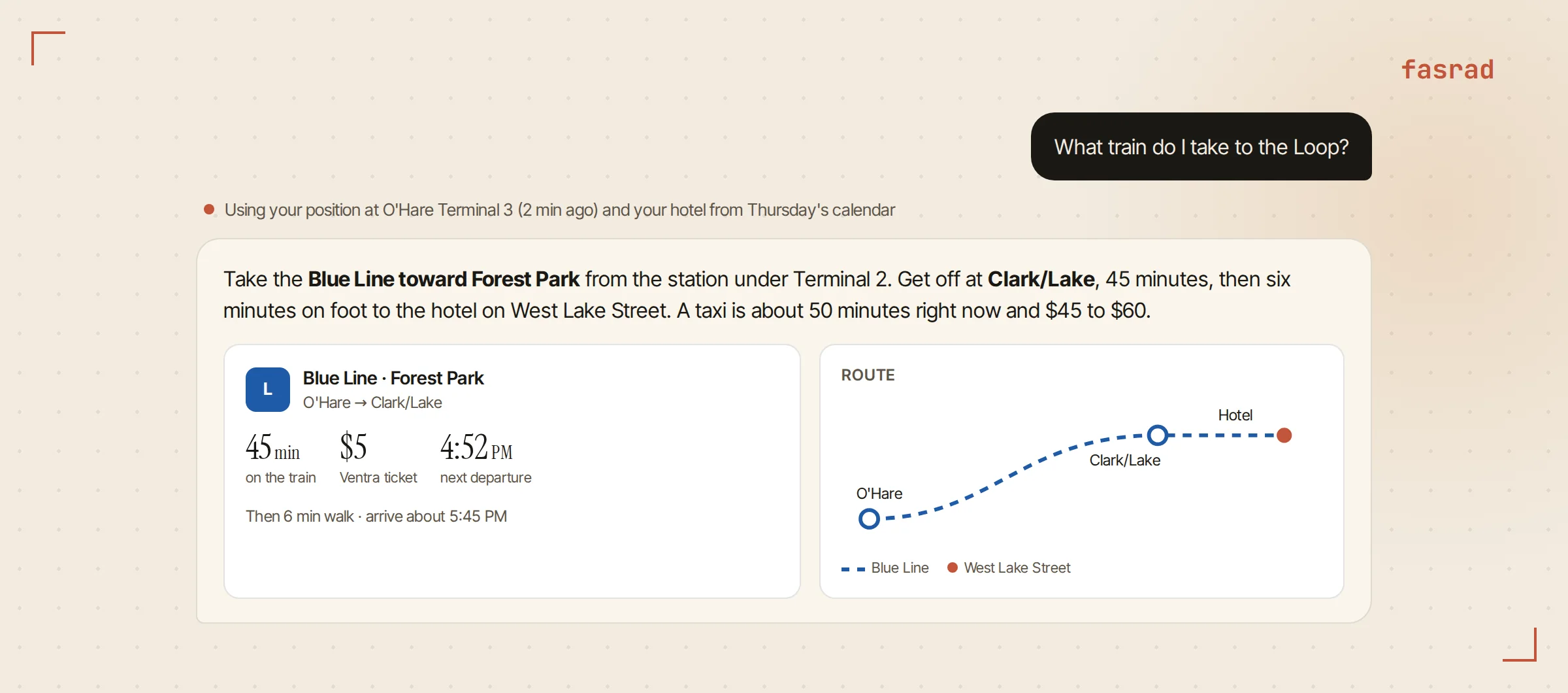
On the train she asks "Should I get off at Clark/Lake or Washington?" and gets one sentence: Clark/Lake, the hotel entrance is on the same side of the street. That is the kind of question a maps app cannot take because it has no idea where the hotel is.
Thursday 6:15 PM, checking in
The hotel emails a confirmation with a different room block and a breakfast voucher. Nora screenshots it and sends "Add this to my calendar". The agent reads the image, updates the stay with the new confirmation number and the breakfast hours, and keeps the address on the event, which is what makes every later directions question work. A personal assistant agent that reads screenshots saves the retyping that most travel admin consists of.
Then: "Somewhere for dinner within ten minutes of here, not a chain, table for one." "Here" resolves to the hotel because she is standing in it. Three places come back with the walking minutes and a map she can zoom, and "Show me the second one on a map" does what it says.
Friday 7:00 AM, the briefing
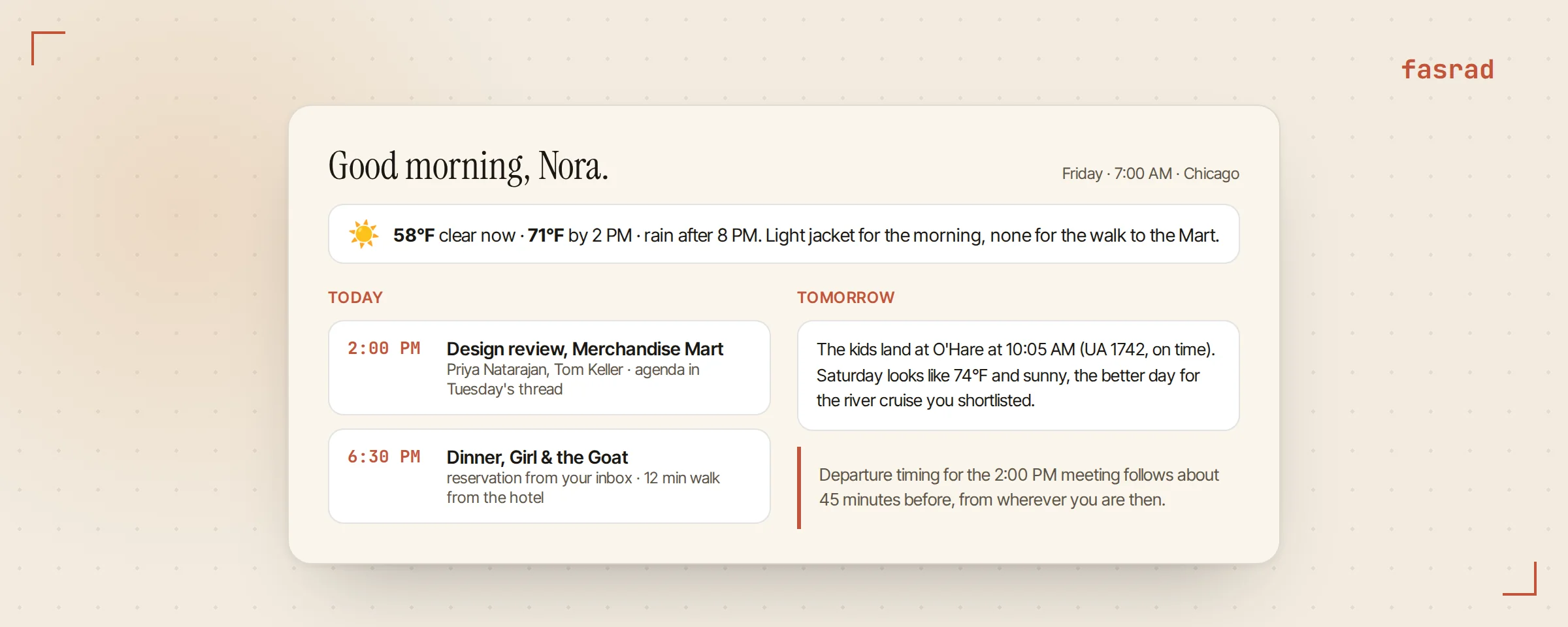
The morning briefing arrives with the weather line first: 58°F and clear at 7:00 AM, 71°F by 2:00 PM, rain moving in after 8:00 PM. Below it, today's calendar: the 2:00 PM meeting at the Merchandise Mart with two people from the client's design team, and a 6:30 PM dinner reservation the agent found in her inbox. What the briefing deliberately does not contain is "leave at 1:35 PM." Departure timing is worked out closer to the event, from where she actually is at that point, so it can never be wrong because she changed her plans after breakfast.
Friday 1:20 PM, walking to the meeting
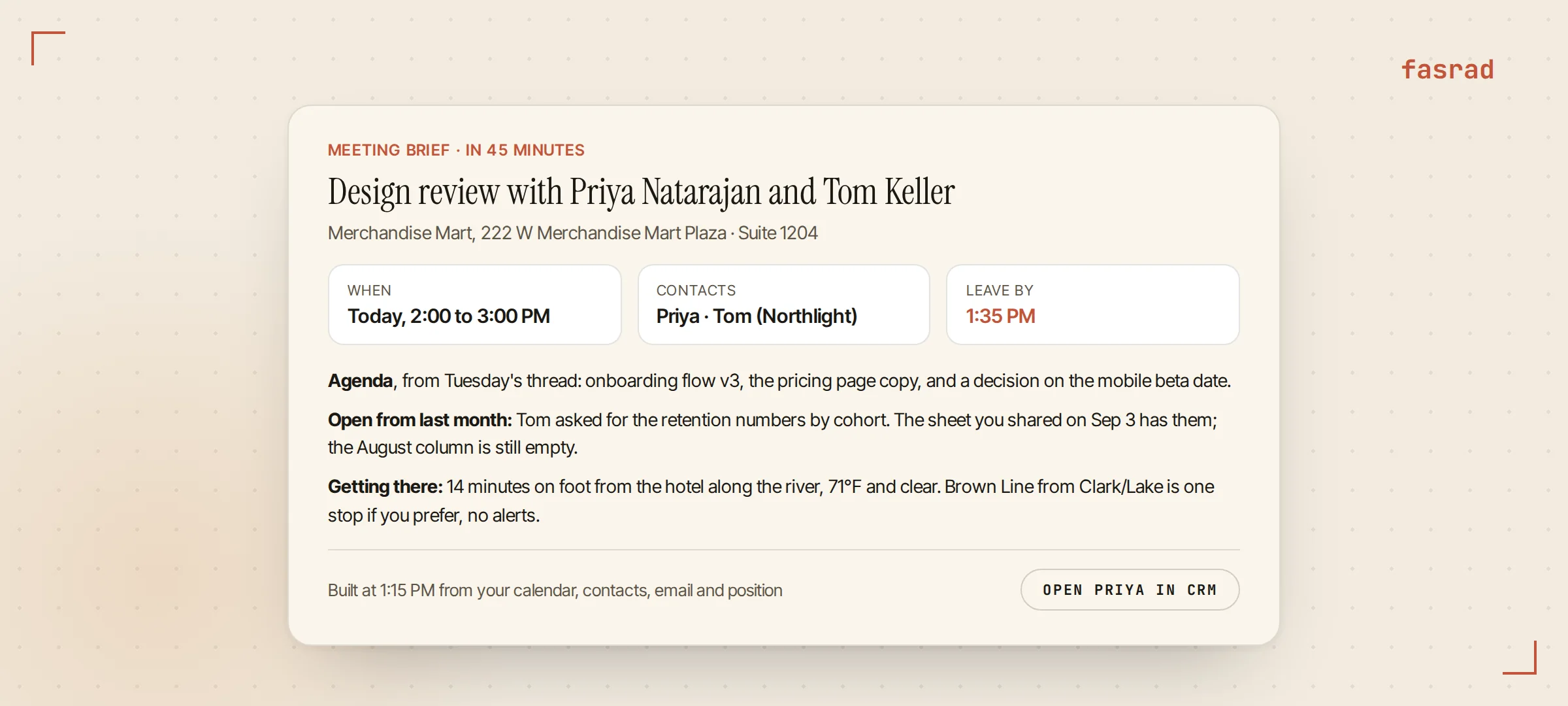
Forty-five minutes before the meeting, the pre-meeting brief lands. It names the two attendees from her contacts, pulls the agenda from the email thread they exchanged on Tuesday, and lists the one open question from last month's call. The logistics line reads: leave the hotel by 1:35 PM, 14 minutes on foot along the river, 71°F, no service alerts on the Brown Line if she prefers to ride. The brief is built when it fires, not the night before, so a meeting moved to 3:00 PM produces a brief for 3:00 PM.
After the meeting she types "Walking directions to the Art Institute", and the agent gives the route from the Mart, 22 minutes, with the Michigan Avenue entrance, because that is where she is now. A calendar-connected agent also adds the dinner walk time to the reservation without being asked.
Saturday, the kids arrive
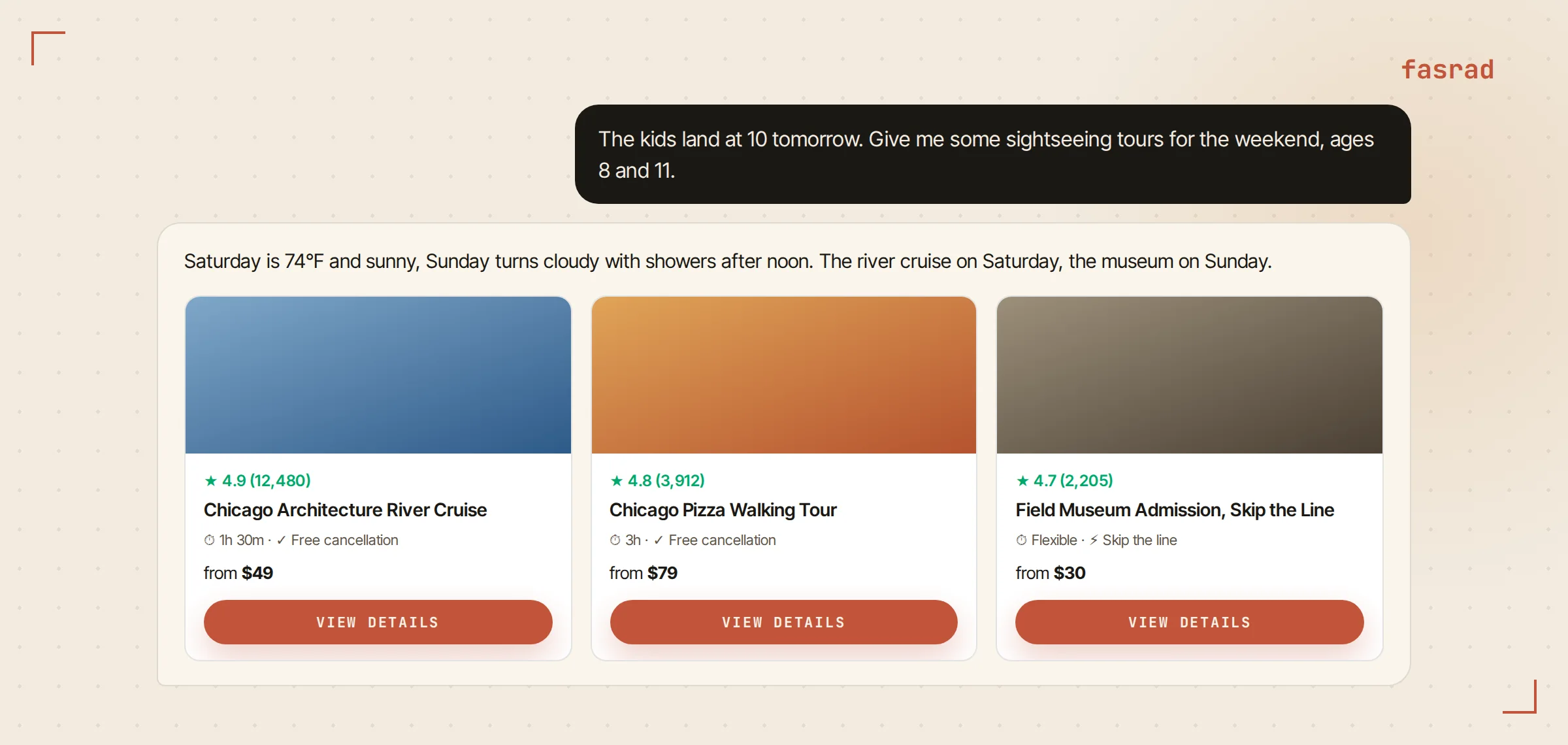
On Friday night Nora sends "The kids land at 10 tomorrow. Give me some sightseeing tours for the weekend, ages 8 and 11." The agent searches Viator for Chicago and returns bookable cards with price, duration, rating, and free cancellation where offered: the architecture river cruise, a Chicago-style pizza tour, and a Saturday afternoon slot at the Field Museum with skip-the-line entry. Each card opens the booking page. It leads with Saturday's weather, 74°F and sunny, and suggests the cruise for Saturday and the museum for Sunday, when the forecast turns.
Saturday morning the family is standing at Navy Pier when she asks "What is around here worth seeing with kids?" The agent uses the phone fix, lists the Children's Museum and the Centennial Wheel with walking minutes, and offers a route back to the hotel that passes a good ice cream place. The conversation continues on the walk through a Telegram assistant, same agent, same memory.
What you never had to type
Over two days, the context the agent supplied on its own:
- The origin for every directions question, from the phone or from the calendar.
- The hotel address, read once from a screenshot and reused for the rest of the trip.
- The attendees, agenda and open item for the meeting, from contacts and email.
- The weather for each decision, at the right place and hour.
- The departure time, computed when it mattered and not before.
- The kids' ages, remembered from the first message that mentioned them.
Set the Track Location switch, share a location on Telegram once, and put the trip on the calendar. The rest is asking questions the way you would ask a friend who lives there.
Frequently asked questions
Do I have to share my location for this to work?
No. Without a device fix the agent works from your calendar and what it remembers, such as a hotel booking or your home city, and it tells you it is using an expected position rather than a live one. Sharing a location from your phone or on Telegram makes answers precise to the block.
How does the agent decide which train or bus to recommend?
It looks up live transit routes between your position and the destination, including line names, departure times and walking connections, and can anchor the search to a departure or arrival time you give it. It reports the route as text and, if you ask for it, as an interactive map.
Will it wake me up with directions the night before?
No. The day-before message only carries information that helps you prepare, such as the weather at the destination or a known disruption. Departure times and connections come from a check that runs shortly before the event, from wherever you are at that moment.
What happens if my phone reports a wrong location?
A fix that would require impossible travel since the last one is held until a second reading agrees, and every position the agent uses carries its age. You can also tell the agent where you are in plain words, which overrides the device.
Can I turn location tracking off?
Yes. Track Location in Account Settings stops the web app from asking your browser for a position. The agent then relies on your calendar, your notes and anything you tell it directly.
Does this work outside the United States?
Yes. Transit routing, place search, weather and tours cover the same cities the underlying map and booking services do, and the agent answers in the language you write in.