An AI agent can run the back office of a one-person advisory practice: it imports your contacts into a CRM, builds prospect lists from public directories, writes client handouts from real data, drafts personalized outreach for your review, and reminds you who is waiting on a reply. Below is one working week with a Fasrad agent, told through Dana, a fee-only financial advisor in Raleigh who has no assistant and no plans to hire one.
How to run a one-person advisory firm with an AI agent
Contacts, prospect lists, client handouts, outreach and follow-ups usually eat the week of a solo advisor. Here is what one week looks like when an agent does the hours between the decisions.
Fasrad · September 16, 2026 · 5 min read
Monday: the contacts
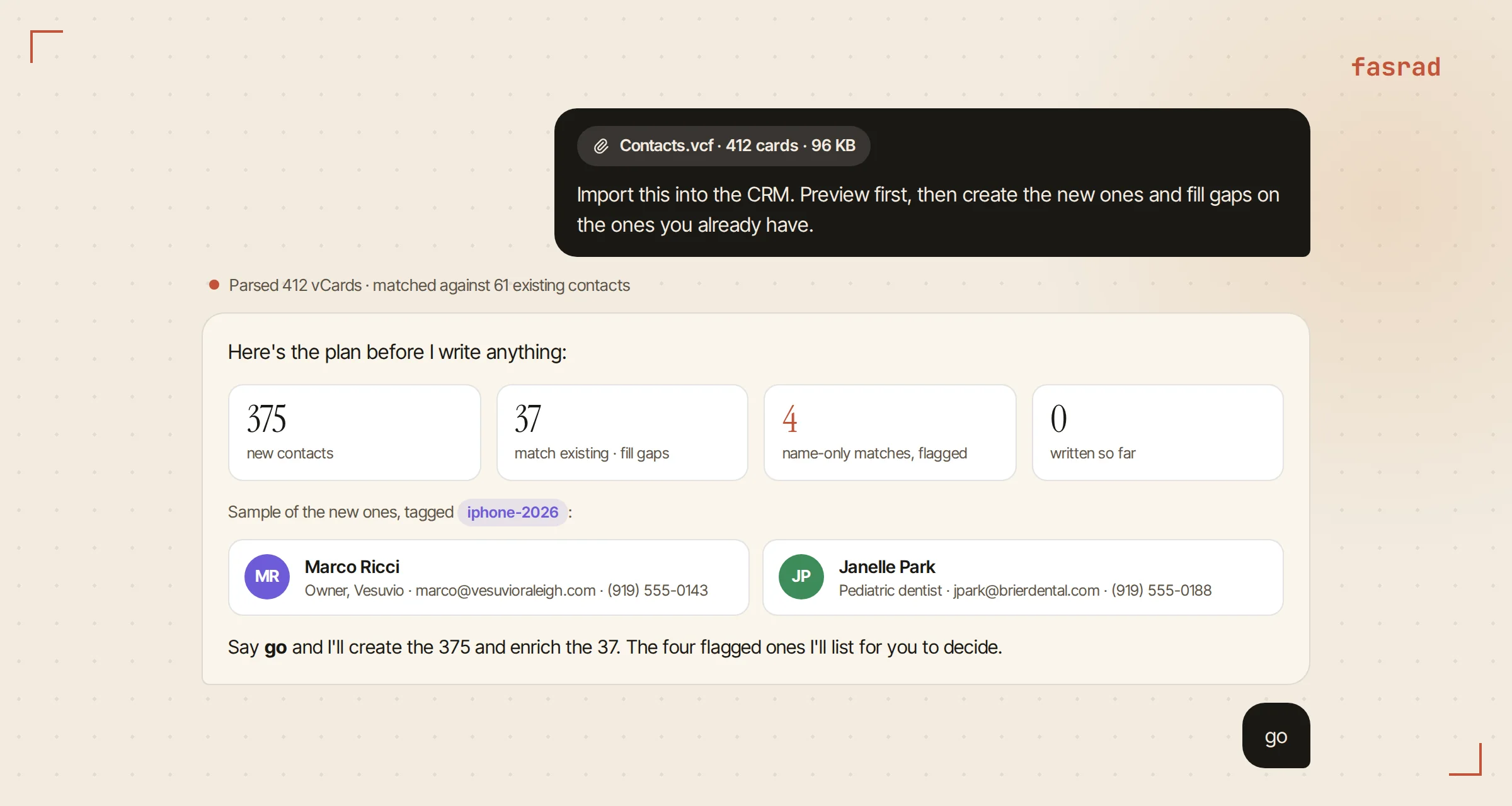
Dana's client and prospect list lived in her iPhone, in a Google account from a previous firm, and in her head. Monday morning she exported the iPhone contacts as a vCard file, dropped it into the chat, and typed: "Import this into the CRM. Preview first, then create the new ones and fill gaps on the ones you already have."
The agent read 412 cards and came back with a plan before writing anything: 375 new contacts, 37 that matched people already in the CRM by email or phone, and four name-only matches it flagged instead of guessing. She approved, and the AI personal CRM had her whole book in it by 9:15, tagged by source so she could tell the old firm's leads from her own.
The Google export was a CSV, and that went the same way, with the columns mapped automatically. Every contact now had a timeline, which mattered by Friday.
Tuesday: the prospect list
Dana wanted a niche: independent restaurant owners, who tend to have irregular income, no retirement plan, and nobody advising them. She typed: "Build me a list of independently owned restaurants in ZIP codes 27601, 27603, 27605 and 27608. I want name, address, ZIP, phone, website and where you found it. Skip chains."
The agent created a datastore called Restaurant prospects, then worked through the county's public directory page by page, one row per listing, and skipped anything that appeared on a franchise list. Ninety-six rows, deduplicated by phone number, in about twelve minutes. She asked for the table in chat, sorted by ZIP, and spot-checked ten of them against their websites. Two were closed. She deleted them in the table view, which left 94, and moved on.
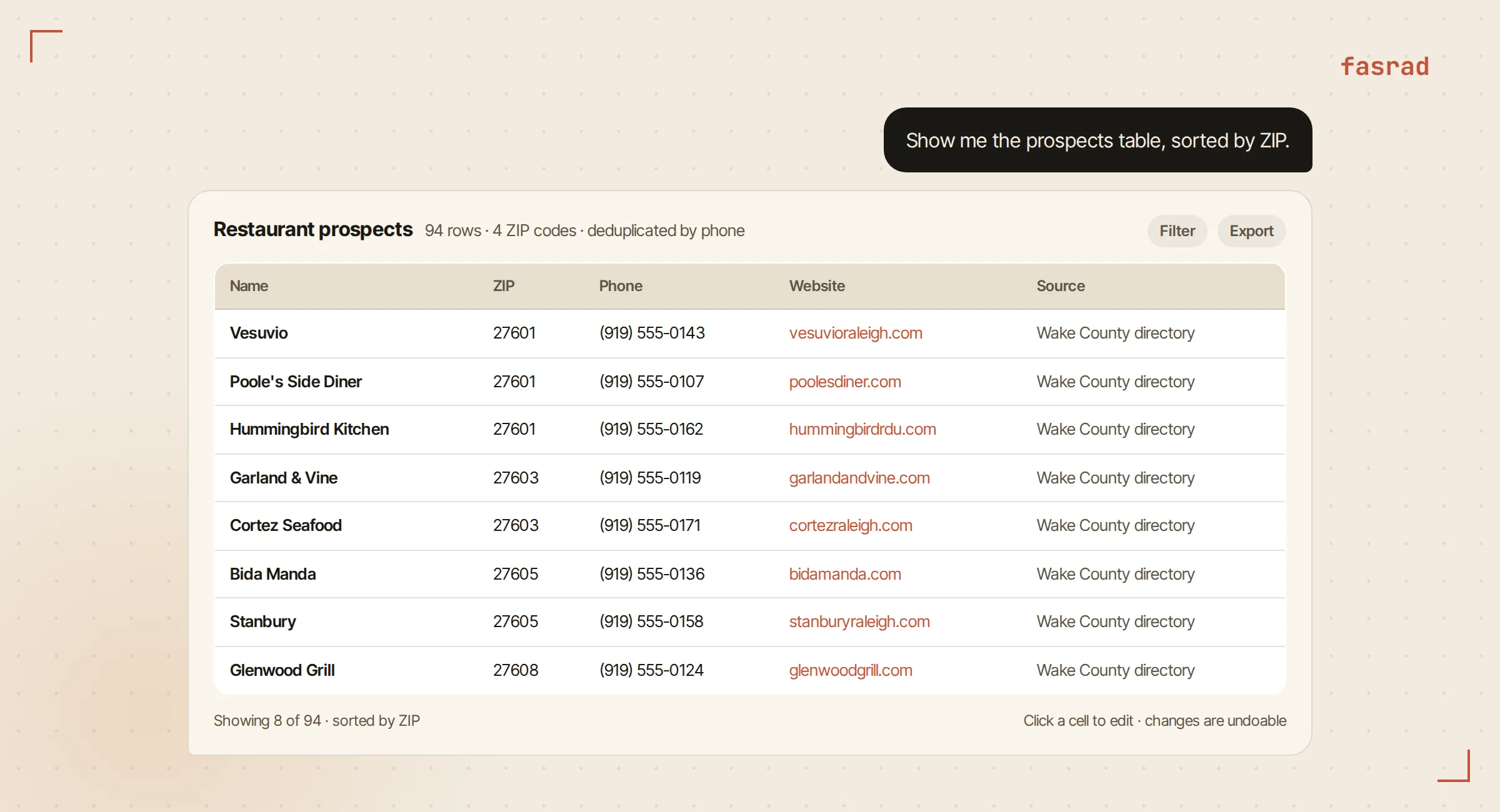
The same list feeds everything that follows. The agent can query it, update it in bulk with a dry run first, and export it to Excel when Dana's compliance reviewer asks for a copy.
Wednesday: the client one-pager
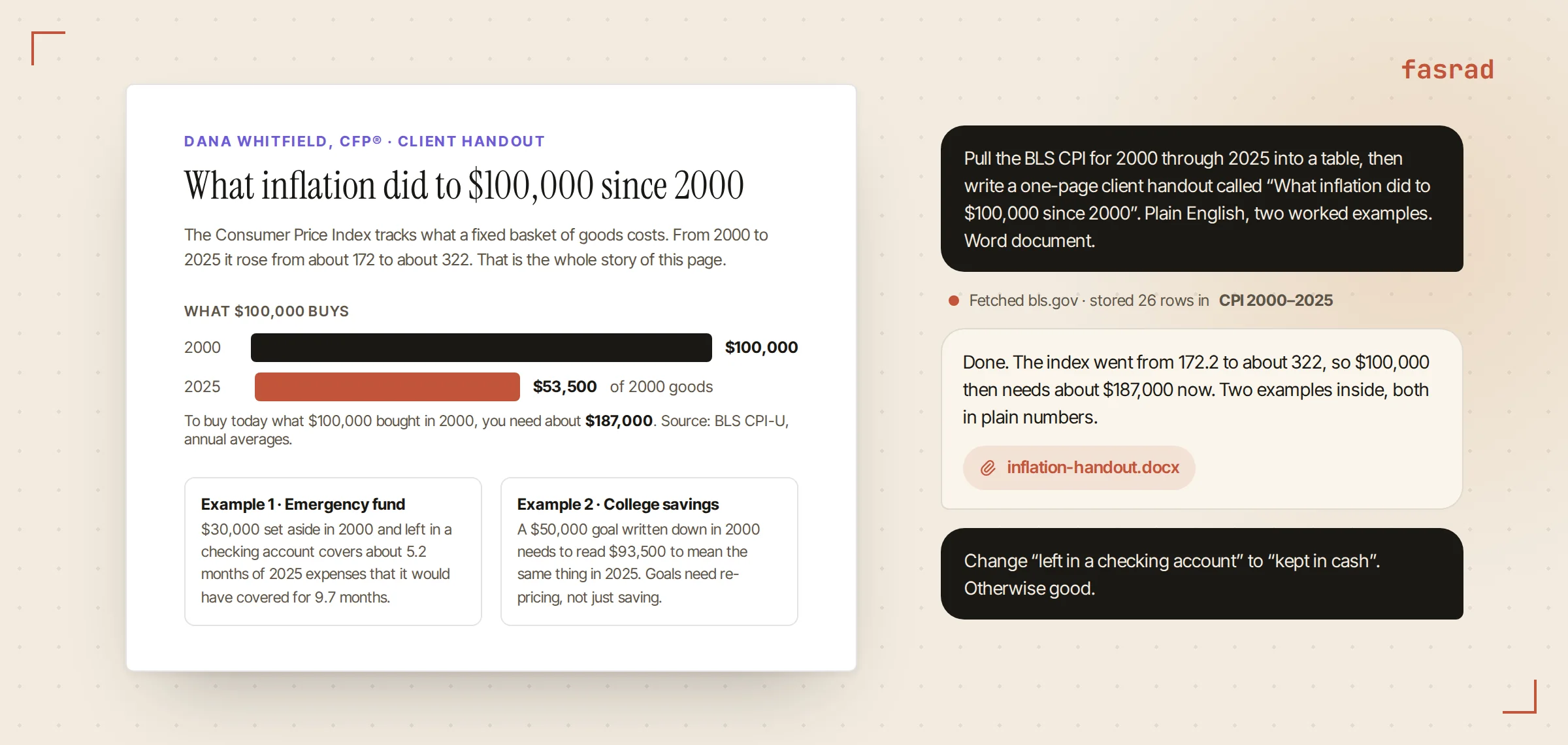
Client meetings kept circling back to one question: why does the account feel smaller than the balance says? Dana asked for a handout. "Pull the BLS consumer price index for 2000 through 2025 into a table, then write a one-page client handout called What inflation did to $100,000 since 2000. Plain English, two worked examples, no jargon. Word document."
The agent fetched the index values from the Bureau of Labor Statistics, stored the 26 rows, and did the arithmetic: the CPI-U rose from about 172 in 2000 to roughly 322 in 2025, so it takes about $187,000 today to buy what $100,000 bought then. Put the other way, $100,000 kept in cash since 2000 now buys about $53,500 worth of goods. The two examples were a retiree's emergency fund and a college savings balance. The document arrived as an attachment in the chat, and Dana changed one sentence.
Because the agent keeps the CPI table, next January's update is a one-line request. The advisor agent page shows more of what it can produce from the same kind of source material: comparison sheets, meeting summaries, plain-language explainers.
Thursday: the outreach
Cold email to 94 restaurant owners is where most solo practices stall, because each message needs a first line that proves you looked. Dana typed: "Draft an intro email for each restaurant in the prospects table. Two short paragraphs. Open with something specific to their place from the website. Put the drafts in the table so I can review them."
The agent wrote 94 drafts, each with a different first line: a mention of the wood-fired oven on one site, the 2019 opening date on another, the second location in Cary on a third. Dana read through them in the table, rewrote eleven, and deleted three prospects that felt like a bad fit. Then she chose how they would go out. She could copy them into her own mail client, or let the agent send them from its own address at a pace she set, twenty a day, after she authorized the recipients. The agent sends to nobody it has not been cleared to write to, which is exactly the control an advisor wants around outreach.
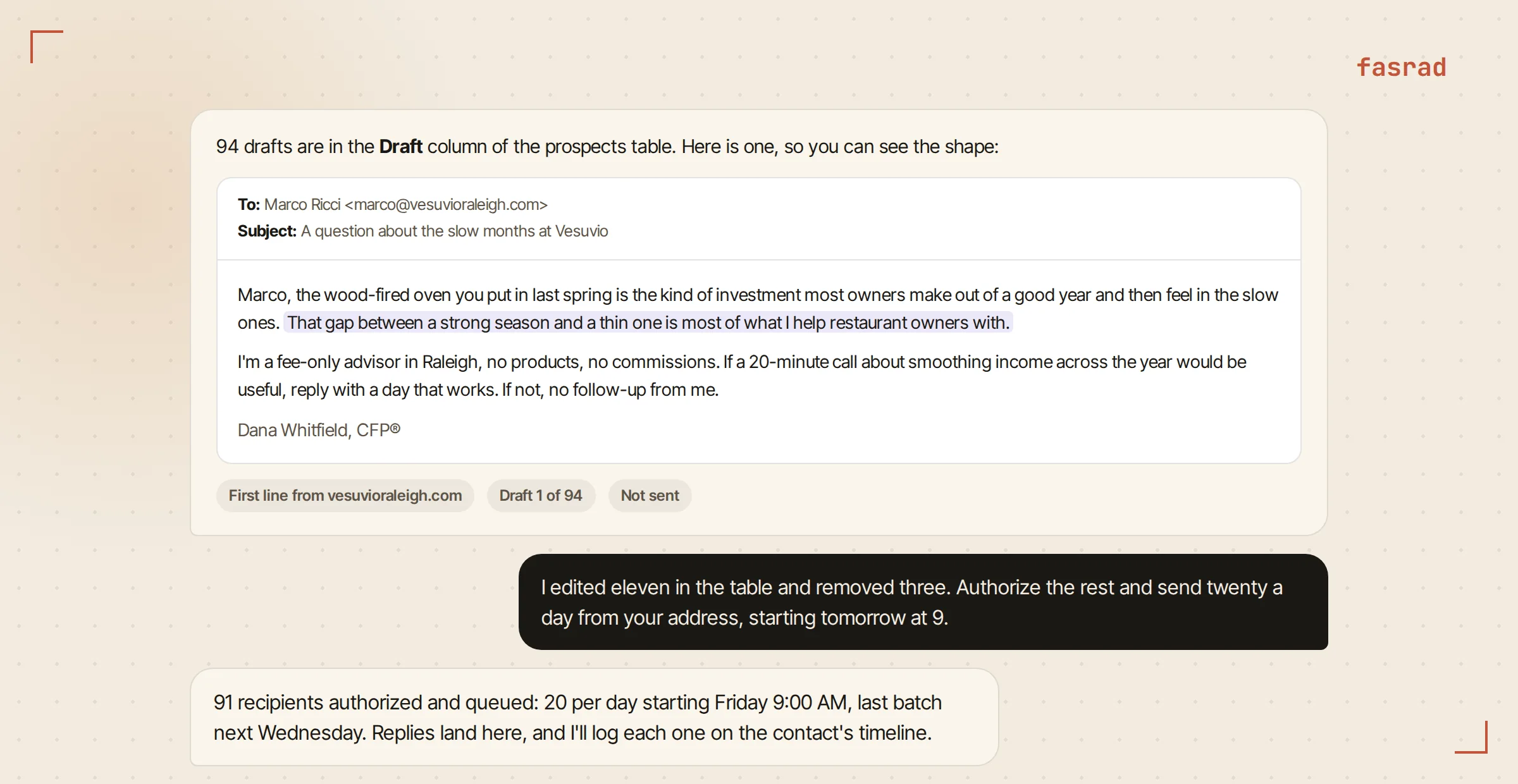
The cold outreach agent page covers the sending side in more depth, including replies landing back in the same conversation.
Friday: the follow-ups
Three owners had replied by Friday. Dana logged each call as she made it: "Log a call with Marco at Vesuvio, he wants a plan review in October." Each note went on the contact's timeline. Then she asked for the stale view of the CRM, which lists everyone whose last interaction is older than their check-in interval, and worked down that list until lunch.
The agent had also set its own reminders during the week. On Wednesday it had asked whether the one-pager landed well with the first client who received it. The following Tuesday it would ask how the October review with Marco was shaping up. Dana never wrote a to-do list; the follow-ups arrived in the chat, phrased as questions, when the answer would exist.
What this replaces
| Task | Before | Now |
|---|---|---|
| Merging contact lists | A Saturday with two spreadsheets | Drop the file, approve the preview |
| Prospect list of 94 restaurants | Two evenings of copying from a directory | One request, twelve minutes, spot-check ten rows |
| Client inflation handout | An afternoon in Word and a calculator | One request, edit one sentence |
| 94 personalized intro emails | A week of writing, or a template nobody answers | Review drafts in a table, set the pace |
| Remembering who to call back | Sticky notes | The stale list and follow-ups that ask you |
The judgment about who to call and what to recommend stays with the advisor. An inbox and back-office agent takes the hours between those decisions, and keeps a record of every one of them.
Frequently asked questions
Where do my contacts come from?
From the files you already have. A vCard export from an iPhone or Mac is imported with a preview first, matching people by email, phone and name, and only writing when you approve. A CSV from Google Contacts or an old CRM is imported with the columns mapped automatically.
How does the agent build a prospect list?
You name the source and the columns you want. The agent walks a public directory or listing page by page, extracts one row per entry into a private datastore, deduplicates on a column you choose, and shows you the table in chat to filter, edit and export.
Does the agent send outreach emails on its own?
Only to recipients you have authorized, at a pace you set. Drafts go into your prospect table for review first. You can send them yourself from your own mail client, or let the agent send from its own address with a daily limit, and replies land back in the same conversation.
What kind of documents can it produce?
Word documents, Excel workbooks, PDFs and slide decks, built from data the agent fetched or from files you upload. The inflation handout in this article is a Word document created from a table of BLS index values the agent stored, so next year's update is one request.
Is the client and prospect data private?
Yes. Contacts, prospects and documents live in your own Fasrad account, in datastores only your agent can read. Bulk changes run as a dry run first and can be undone for 90 days.
Will it remind me to follow up?
Two ways. The CRM has a stale view listing contacts whose last interaction is older than their check-in interval. The agent also schedules its own follow-ups after meaningful work, and asks you in chat when the outcome should be known.