Most vocabulary lists are full of words you already know. Claire's handout for the first week of Portuguese had 40 words on it, and she could have defined 31 of them before the class started.
Learn a language with an AI tutor
Four weeks of Portuguese, zero flashcards typed. The deck grew from the words she stumbled on, and test night ended with a printed sheet of the ones she missed most.
Fasrad · October 12, 2026 · 4 min read
So for four weeks she ran an experiment. She did her Portuguese with an AI tutor in chat, never typed a single flashcard, and let the deck build itself from the words she actually stumbled on. On the night before her unit test, the tutor printed the ones she'd missed most. Here's how the deck grew, week by week.
Week 1: cards from the sentences she got stuck on
Claire switched on the Study skill and told her agent, Tess, "make me a deck called Português A2". Then she went back to her homework.
The homework was writing. She pasted in "Eu fui à feira ontem e comprei muitas frutas" and asked whether it was right, and whether "feira" was the market or the fair. Tess answered both. Then it previewed a card: "feira", meaning street market, with her own sentence underneath as the example. She typed yes, and the card was saved. Nothing goes into the deck without that yes.
A sentence from her landlord's WhatsApp went the same way. She pasted it to ask what "fiador" meant, and Tess offered a card for it with the landlord's sentence attached.
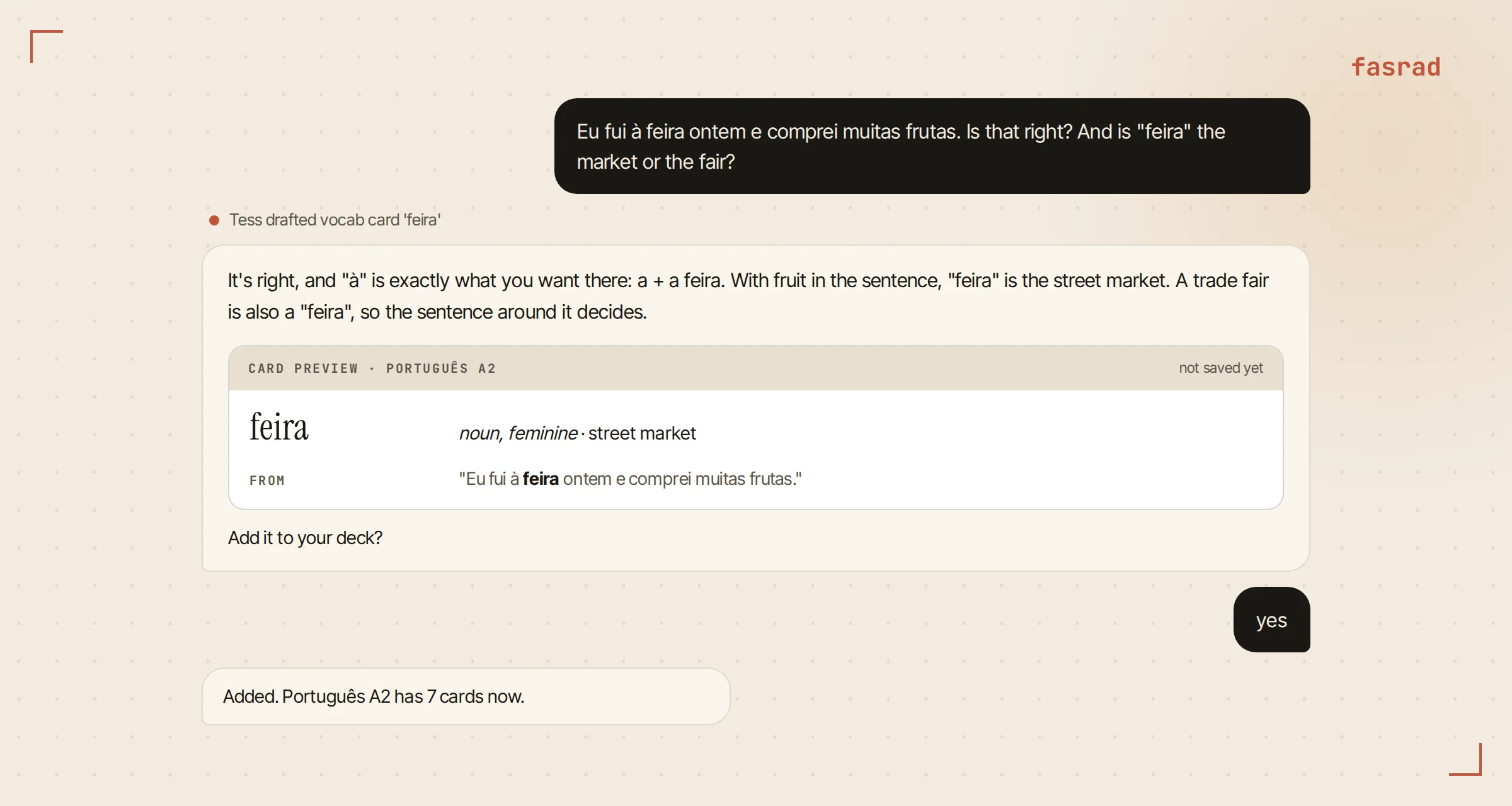
By Sunday the deck had 18 cards. She knew none of them on Monday. The same deck tools run a study companion for history and science notes. That's the whole point of building it this way, and it's what a printed list can't do.
Week 2: a class reading becomes 20 candidates
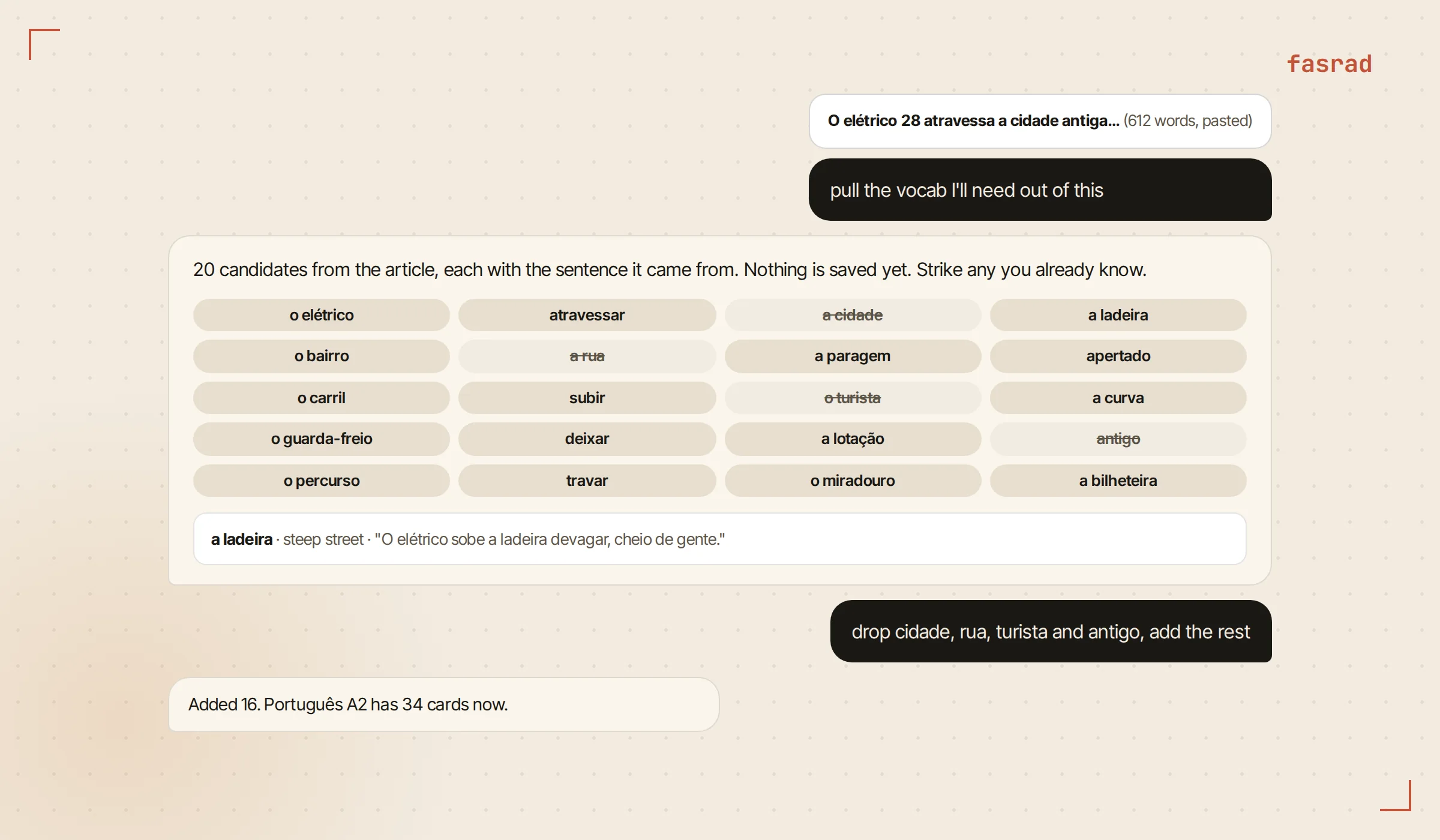
Week two's assignment was a 600-word article about Lisbon's trams. Claire pasted the whole thing with "pull the vocab I'll need out of this".
What came back was a preview of 20 candidate cards, each with the sentence from the article it came from. Nothing was saved yet. She struck out the four she knew cold, "cidade", "rua" and two others, and confirmed the remaining 16 in one message. A second reading on Thursday added 18 more.
The strike-out step is the part worth doing carefully. It's ten seconds of reading, and it's what keeps the deck from filling up with "rua".
Deck count on Sunday: 52. Words looked up while reading on a Kindle can land in the same deck, as the reader's guide shows.
Week 3: quizzes on Telegram, answered in Portuguese
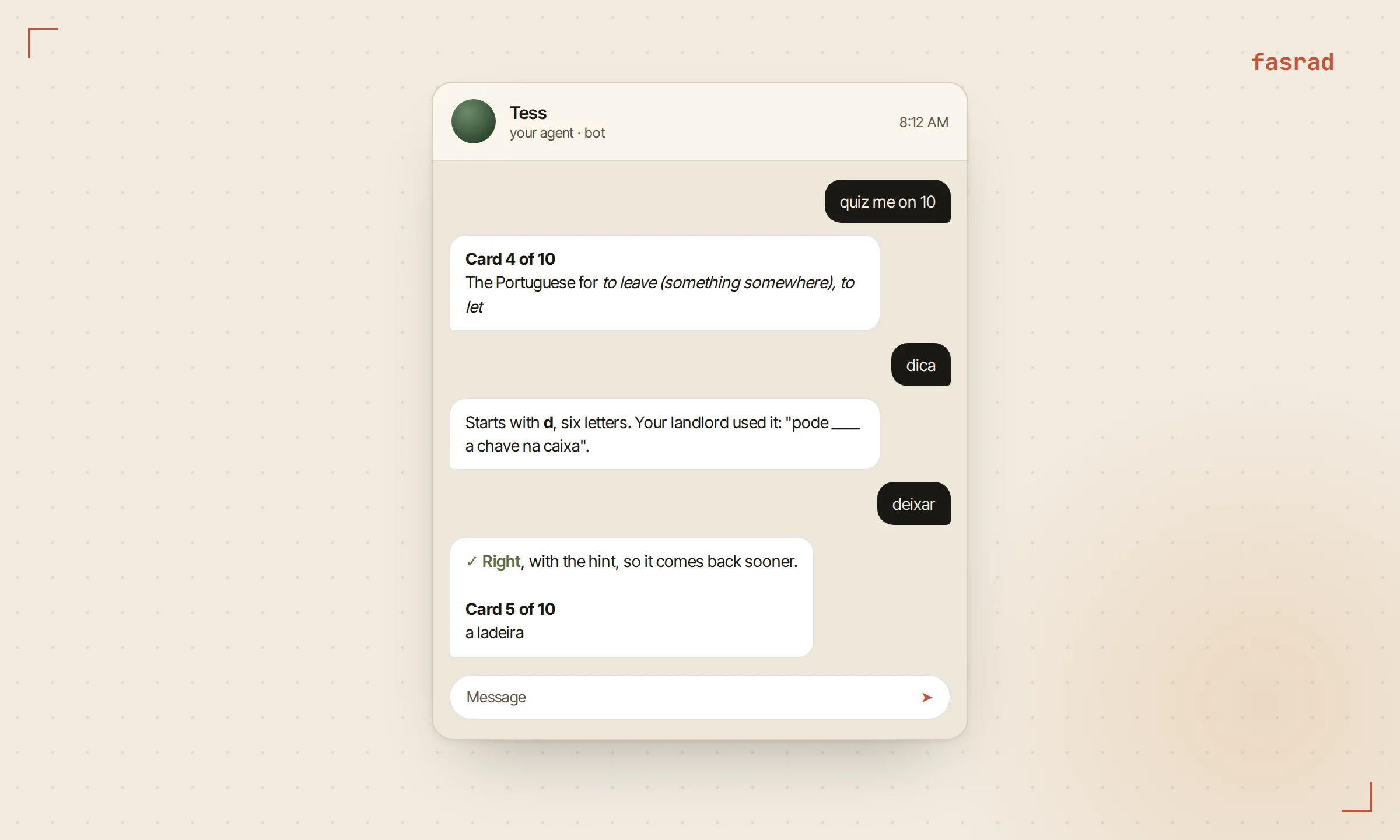
Reviews moved to her phone. "Quiz me on 10" on Telegram starts a session of up to ten cards, one at a time. She types an answer and it's graded before the next word arrives.
The grading is stricter than a multiple-choice app and kinder than a red X. An answer one letter off on a short word gets a typo check instead of a fail. On longer words the allowance grows to two letters, then three past twelve. When she typed the English meaning on a card that wanted the Portuguese word, Tess told her she'd typed the meaning and asked for the word. Typing "dica", Portuguese for hint, gets a one-line clue. A right answer after a hint counts as hard, so the card comes back sooner and doesn't move up a level. The cards she gets right climb from recognizing the word to producing it from the meaning.
Speaking went through the same chat. A voice message in Portuguese gets transcribed and answered in Portuguese, and Claire told Tess once to correct her grammar at the end of every reply rather than in the middle. On the walk home she'd type /call in Telegram and talk for ten minutes about whatever she'd done that day, in slow and badly conjugated Portuguese that Tess answered at the same speed. Afterward she'd ask in chat about the words she'd reached for and missed.
Nine cards came out of week three that way, and the deck reached 61.
Week 4: "what's giving me trouble?"
Claire asked exactly that on Tuesday. Tess listed the five cards with the most lapses, worst first. "Deixar" topped it with six misses. A line under the list said four of the five were verbs.
That pattern was more useful than the list.
She asked why she kept missing "deixar", and the answer used the three sentences in her own deck where it appeared. One was the landlord's. The others came from the tram article. Three new cards went in that week, all verbs. Deck count: 64.
"Is 'saudade' in my deck?" gets a straight answer too: the card's state, its lapses, and when she last saw it. She checks that kind of thing before adding a card twice. The AI language tutor setup is the same agent with these study tools switched on.
Test night: the printed sheet
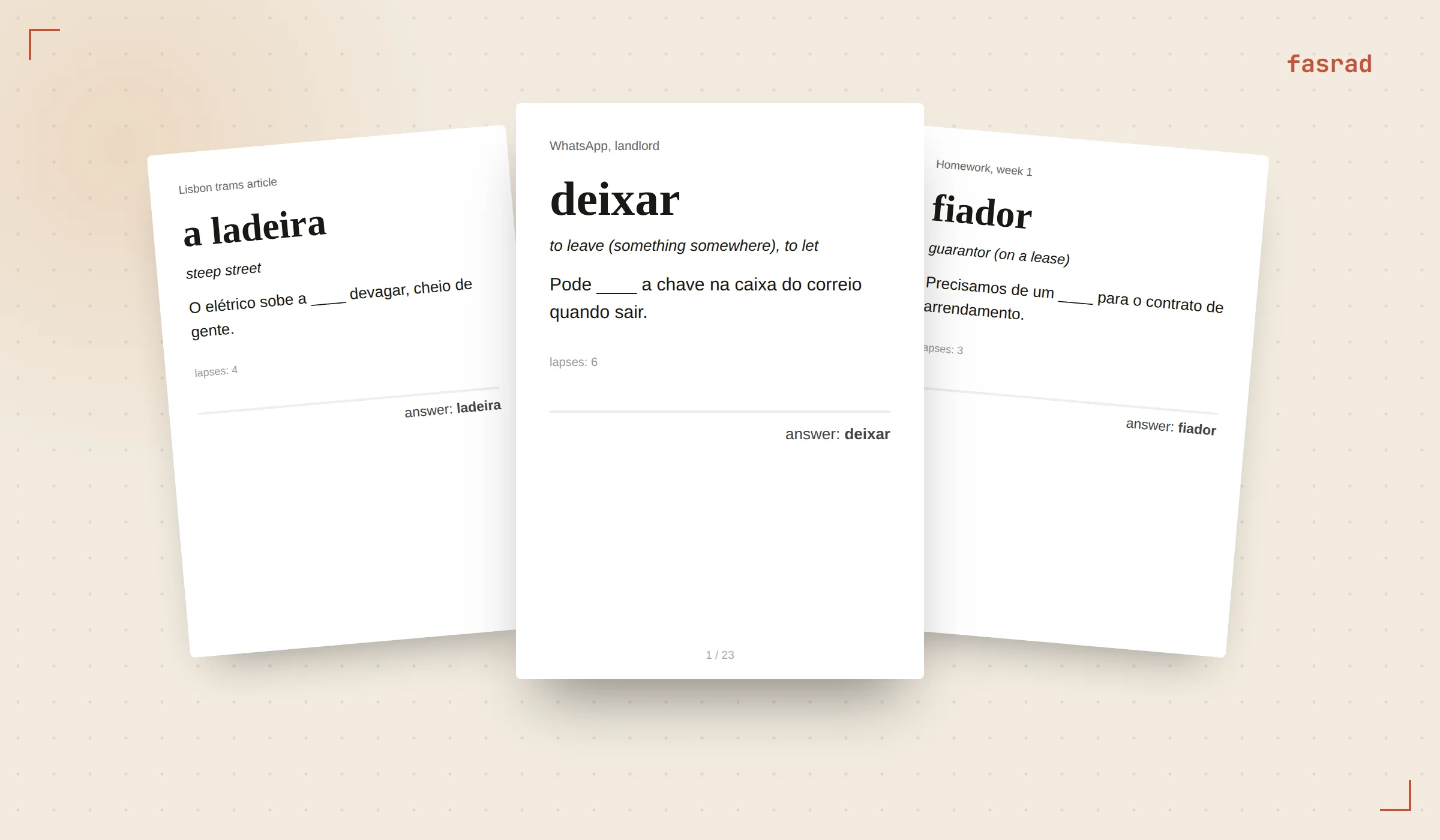
"Print my most-missed words" produced a PDF on Wednesday night. It covers the last 30 days by default and takes up to 50 words, worst first. Claire had missed 23 different words in that time, so she got 23 pages.
Each page holds one word in large type, with where the card came from above it and the meaning below. Under that sits her original sentence with the word blanked out. The lapse count and the answer close out the bottom of the page. On the train she covered the top half with her hand and filled in the blanks from the sentences alone, which is harder than it sounds when the sentence is your landlord's. "Deixar" was on page one.
Frequently asked questions
Do I have to type flashcards myself?
No. When you ask about a word in context, the tutor previews a card with the sentence it came from, and one yes saves it. A pasted reading turns into up to 20 candidate cards at once.
Does anything get added to my deck without asking?
No. Every card and every batch from a reading is shown as a preview first. You strike the words you already know and confirm the rest.
Can I practice on my phone?
Yes. Ask for a quiz on Telegram and it runs one card at a time with typed answers graded on the spot. Voice messages get transcribed and answered, and /call starts a voice conversation.
What happens if I make a typo?
A small slip gets a typo check instead of a fail. The allowance scales with word length: one letter on short words, two on medium ones and three past twelve letters.
Can I ask for a hint during a quiz?
Yes. Type hint, or the local word such as dica in Portuguese or pista in Spanish, and you get a one-line clue. A hinted answer counts as hard, so the card returns sooner.
How does it know which words I struggle with?
Every review is recorded. Ask what's giving you trouble and you get the cards with the most lapses, plus a note when they share a pattern, such as most of them being verbs.
Can I print my weak words before a test?
Yes. Ask for your most-missed words and you get a PDF of up to 50 words from the last 30 days, one per page, with the original sentence blanked and the answer at the bottom.
Which languages does it work with?
Any language you study in chat. Cards carry a language code, so Portuguese, Spanish, German or Japanese decks all work the same way.