A Fasrad agent sends a morning briefing made of the sections you asked for, in the words you used to ask for them. Renee, a parent in Minneapolis with a 4th grader and a 7th grader, built hers in four sentences over four evenings. Every morning at 6:45 her phone shows the weather, both kids' school calendar and the family calendar, the homework that is still open, and one photo from the family album.
Start your day with an AI morning briefing
A Minneapolis parent tells her agent, one sentence at a time, what 6:45 AM should say: the weather without commentary, the school and family calendars, homework still open, and one photo from the family album.
Fasrad · September 17, 2026 · 5 min read
There is no news feed in it. Each section exists because she said one sentence, and the agent keeps that sentence as a briefing preference until she says otherwise. Here is the briefing section by section, with the sentence behind each one.
The weather, without commentary
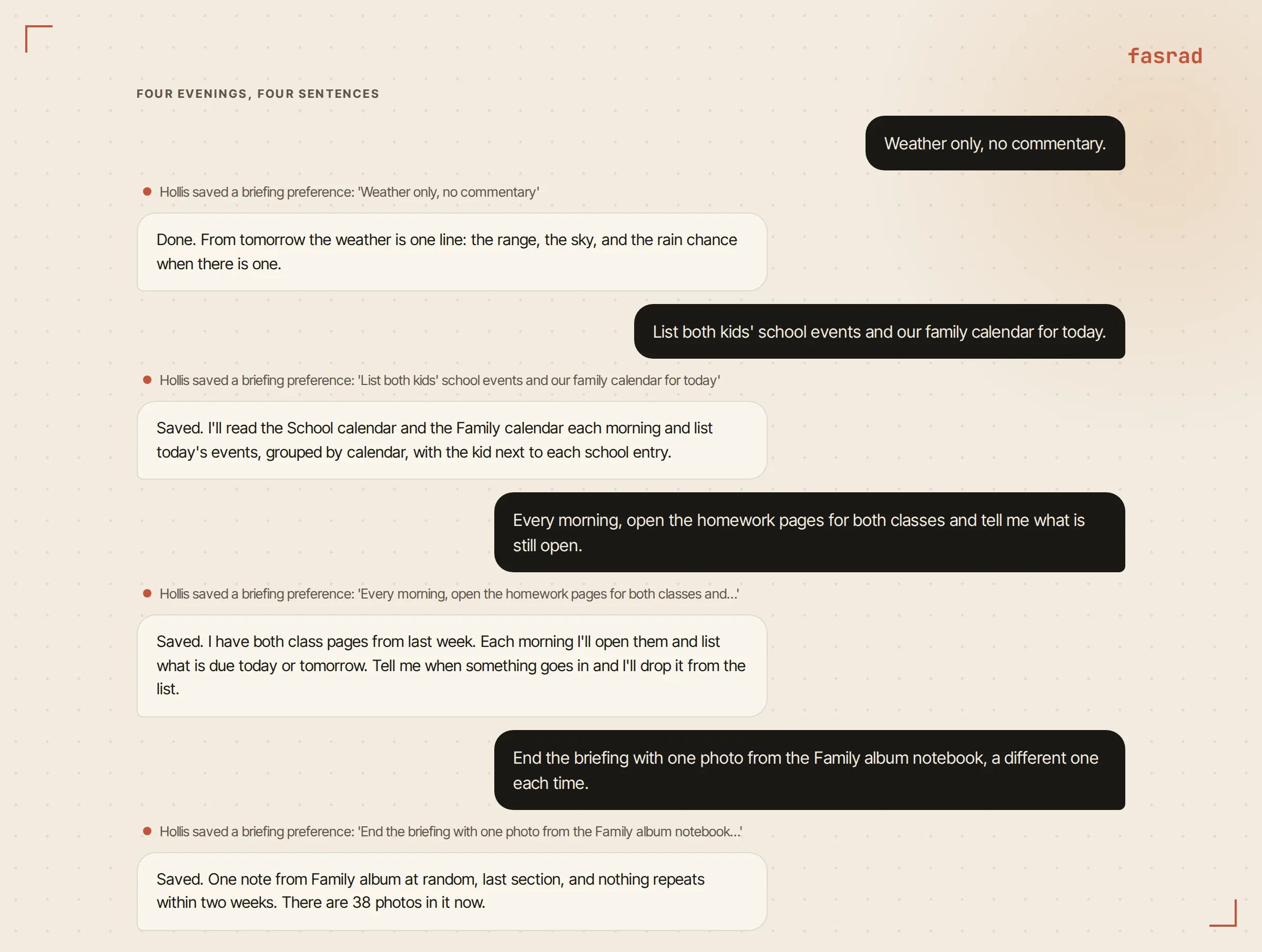
The default weather box changes its angle from day to day: wind one morning, daylight hours the next, a comparison with yesterday after that. Renee wanted none of it. "Weather only, no commentary." The agent saved that as a briefing preference, and the box is now one line: the range, the sky, and the rain chance when there is one.
The location comes from her phone, so the forecast follows her on a trip. She could pin it instead with "Always use Minneapolis for the briefing weather", and the box would stay home while she travels. That is the shape of a personal assistant agent: its configuration lives in the conversation, never in a settings form.
Today's school and family calendars
The agent reads Google Calendar. Connecting one is a single step: share the calendar with the agent's own address, which it hands you when you ask, and the calendar appears by name in the agent's list. Renee shares two. One is the family calendar. The other is a School calendar she filled from the .ics file the district publishes: she uploaded the file in chat, the agent showed a preview, she said go, and the events landed. Uploading next semester's file updates the existing events instead of duplicating them.
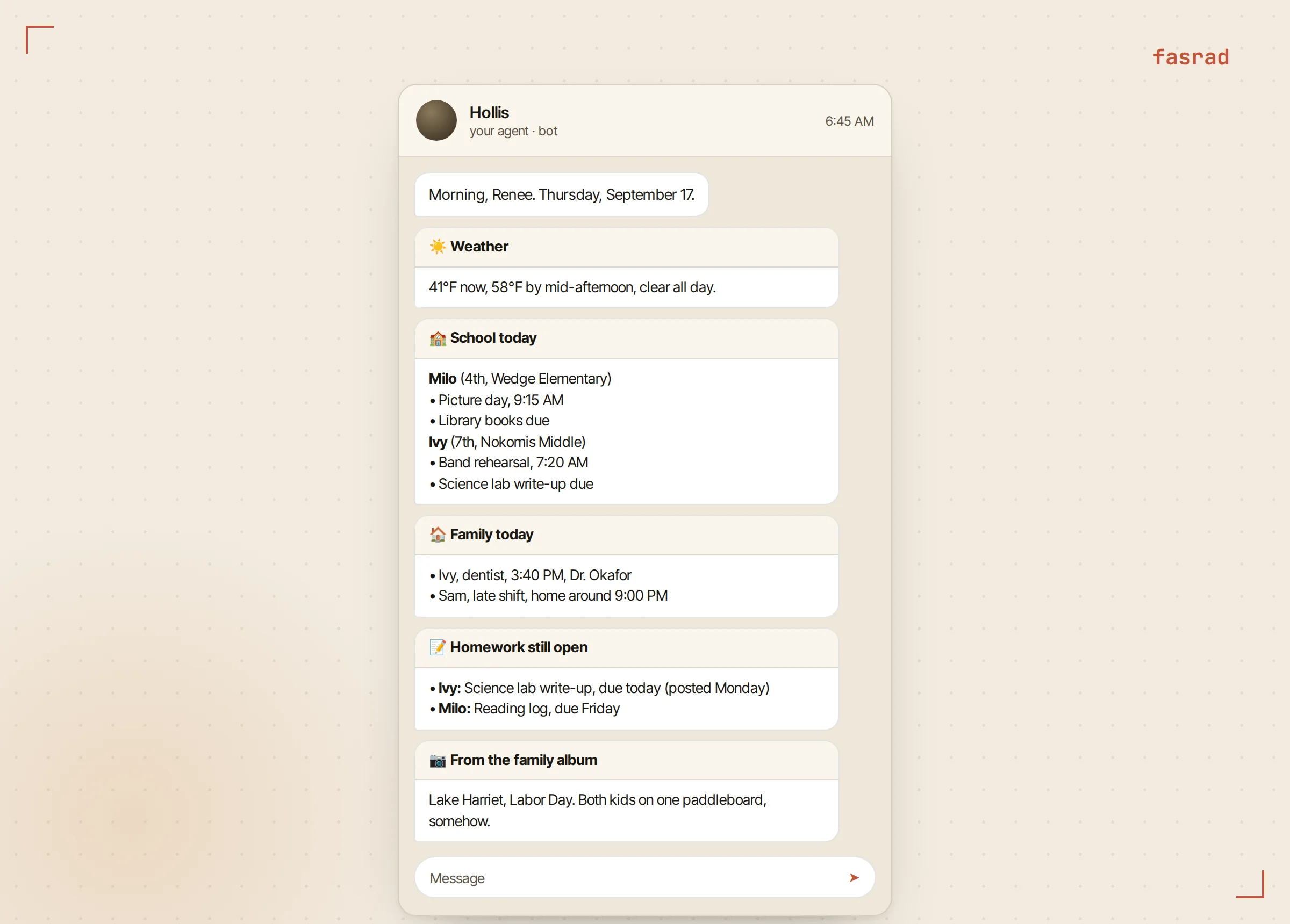
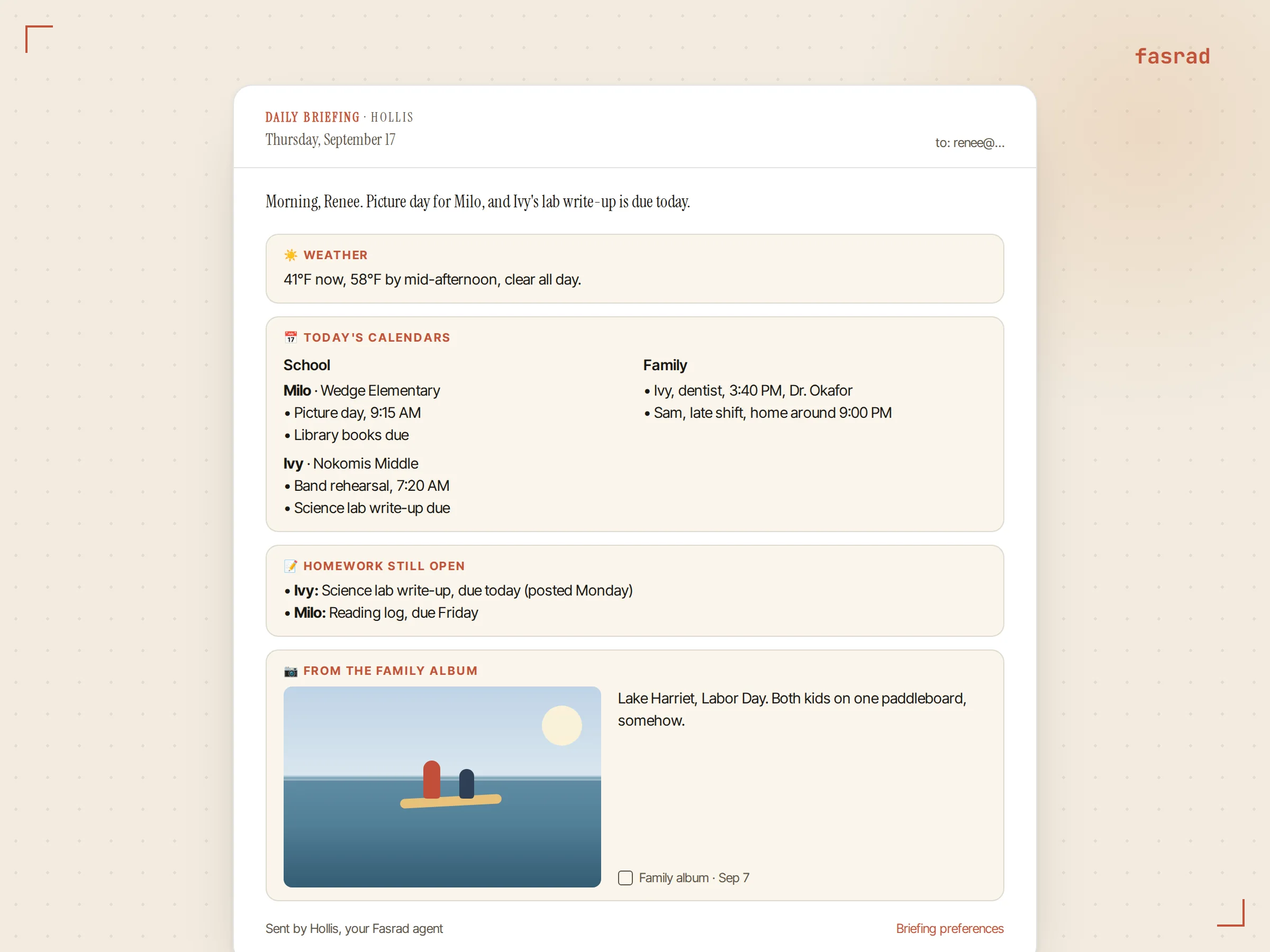
Then the sentence: "List both kids' school events and our family calendar for today." The briefing checks each calendar by name and writes the section grouped by calendar, with each event's time and, for the school entries, which kid it belongs to. The briefing's calendar window is today and tomorrow, so "for today" trims it. On a day with nothing on either calendar the section is simply absent. No "your day is open" filler.
What this section does not do is compute leave-by times. A timed event with a location gets its own short logistics note about two hours before it starts, worked out from wherever Renee is at that moment, so a 6:45 briefing never guesses at traffic for a 3:40 dentist appointment. The AI agent for Google Calendar page covers the rest of what it does with the calendar.
Homework that is still open
Both teachers post assignments on class pages that open without a login. Renee's sentence: "Every morning, open the homework pages for both classes and tell me what is still open." The briefing run has a real browser available, so at 6:45 the agent opens each page, reads the assignments and due dates, and lists what is due today or tomorrow. When something goes in, she says so: "Milo's reading log is done." The agent remembers it, and the next morning's list is shorter. For a page behind a password, the same browser can sign in: give the agent the login once, it fills the form, and the session carries over between mornings.
She added a second sentence for the class that posts at odd hours: "Watch Ivy's science page and tell me when a new assignment is posted." That creates a page monitor. The agent takes a snapshot, checks the page once a day, and sends a message only when something material changed, such as a new assignment, not when a date in the footer ticks over. That message arrives on its own, whenever the daily check runs, not inside the briefing. The Scanner extension has a "Monitor this page" button for the same thing. Monitors watch pages that open without a login.
One photo from the family album
The family album is a notebook in Notes, named Family album. Renee drops photos into it from her phone or laptop, one note per photo, each with a one-line caption. Her sentence: "End the briefing with one photo from the Family album notebook, a different one each time."
Each morning the briefing picks one note from that notebook at random, skipping anything it showed in the last 14 days, and the note becomes the last section. The email version carries the photo itself, scaled to fit the message. The briefing card in the web app shows the note as it looks in Notes, with a link back to it. On Telegram the card carries the caption line; the photo is in the same briefing in the web app, where every delivered briefing is kept.
Sending it to your phone at 6:45
The default is 9:00 by email, or email plus Telegram once the agent has a Telegram bot. Renee reads it while the kids eat, so: "Send it to Telegram at 6:45, not email." One sentence, two settings. The delivery channel switches to Telegram only, and the time moves to 6:45 in her time zone. The briefing arrives within a few minutes of that.
Where she is matters. If the Fasrad tab is already open on her laptop at 6:45, the briefing lands in that chat instead of buzzing the phone. Telegram gets it when she is away from the desk, as a series of cards, one per section. "Send today's briefing again" resends it on the spot, and "Pause the briefing" stops it until she asks for it back. This is the everyday use of a Telegram AI assistant: the same agent, on the phone, with her settings.
Her partner has his own Fasrad account and his own agent. He shared the same two calendars with it and wrote his own sentences, so his 6:45 version lists the same events with a fuller weather line and no album photo.
Changing it with one sentence
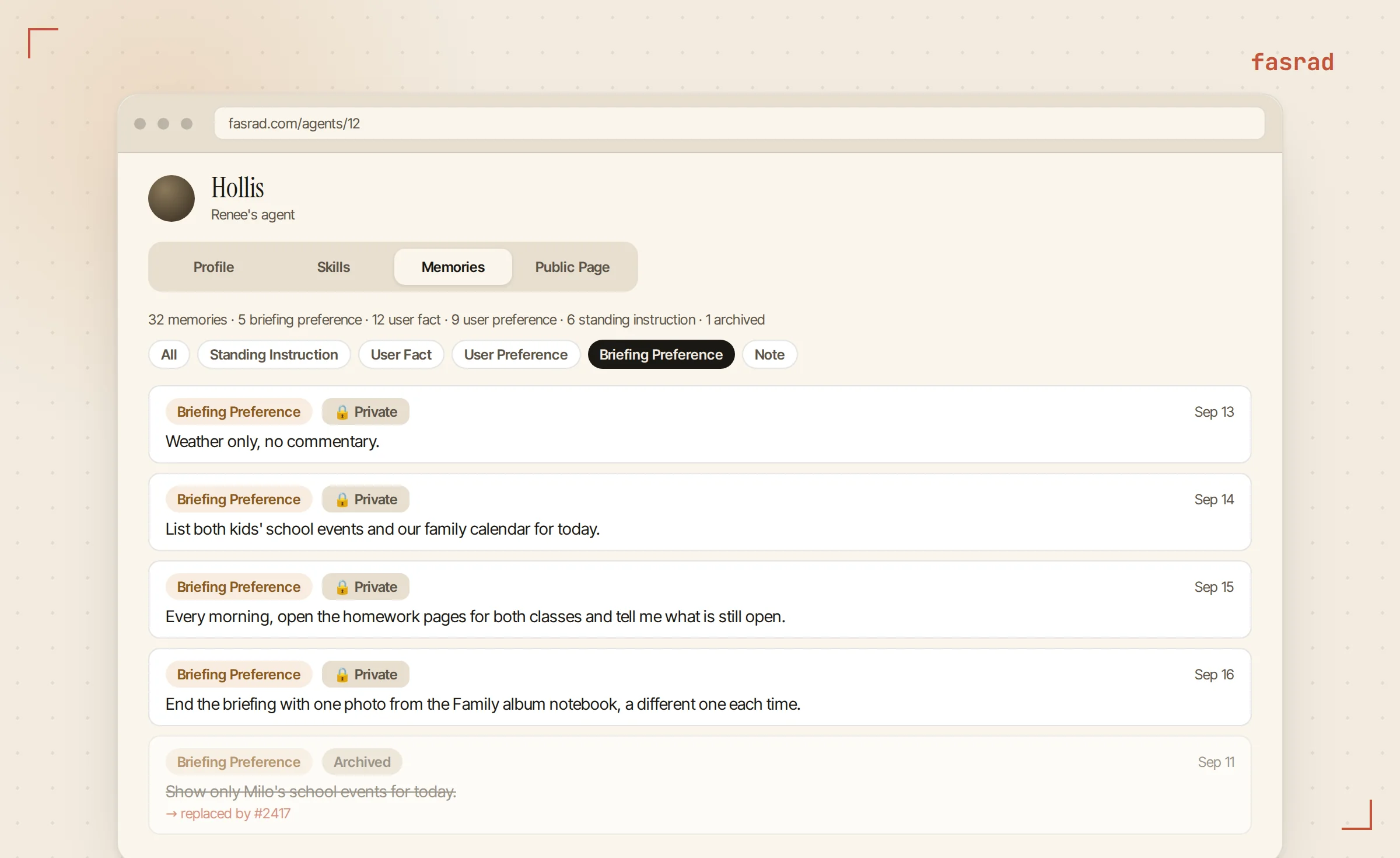
Every sentence above is stored as a briefing preference, and the preferences stack. A new sentence on the same topic replaces the old one and leaves the rest alone: "Show tomorrow's school events too" widens the calendar section and changes nothing about the weather or the photo.
"What are my briefing preferences?" returns the list: whether the briefing is on, the time, the weather location, the channel, and every content sentence. The same list is on the agent's page under Memories, filtered to Briefing Preference, where each entry can be edited or deleted by hand. "Skip the weather" drops a whole section. "No photo at the end" retires that preference. An AI virtual assistant configured by talking to it is easier to keep current than a settings page, and a school year changes often enough to need that.
Four sentences on four evenings, and the mornings since have looked the same: one message, four sections, nothing she did not ask for.
Frequently asked questions
Do I need Google Calendar for the calendar section?
Yes. The agent reads Google Calendar. You share a calendar with the agent's own address, which it gives you when you ask, and the calendar appears by name in its list. A school calendar published as an .ics file can be uploaded in chat and imported, with a preview first and no duplicates when you re-import an updated file.
Can it read a homework portal that needs a login?
The briefing's own check uses a real browser with a persistent session, so you can give the agent the login once and it signs in on later mornings. Page monitors are different: they watch only pages that open without a login and will refuse a login-gated URL.
Does the homework check know what was turned in?
It reads what the class page lists as posted and due. Turned-in status lives inside the school's system, so you tell the agent when something went in, in one line, and it drops that item from the next morning's list.
Does the family photo show up on Telegram?
The Telegram card carries the note's caption line. The photo itself is in the email version, scaled to fit, and in the briefing card in the web app, where every delivered briefing is kept.
What happens on a day with nothing on the calendar?
The calendar section is left out. The briefing never sends a placeholder such as 'nothing scheduled today'; an empty calendar means the section is absent, and the other sections arrive as usual.
Can I get the briefing by email and Telegram at the same time?
Yes. Say 'send it to both' and the delivery channel becomes email plus Telegram. Email only, Telegram only, or both are the three options, and the time applies to all of them.
Can my partner get his own version?
Yes. Each Fasrad account has its own agent with its own preferences. Share the same family and school calendars with both agents and each of you writes your own sentences, so the two briefings list the same events in different shapes.