A Fasrad agent builds a research brief from the documents you already have and the parts of the web you have not read yet. Drop the files into the chat, state the question the brief has to answer, and the agent reads every page, searches for what your files leave out, and publishes a report with sections, a sources table, and a chart, behind a link you can send to anyone. This is how Owen, a product manager in Seattle, went into a Thursday leadership meeting with a view he could defend.
Create a research brief with an AI agent
Five documents in the chat, the web for what they miss, a shareable report with sources and a chart, an article folded in from the browser, and a one-page PDF for the meeting. Two days in the life of one product manager.
Fasrad · September 17, 2026 · 4 min read
Tuesday afternoon: five documents, one question
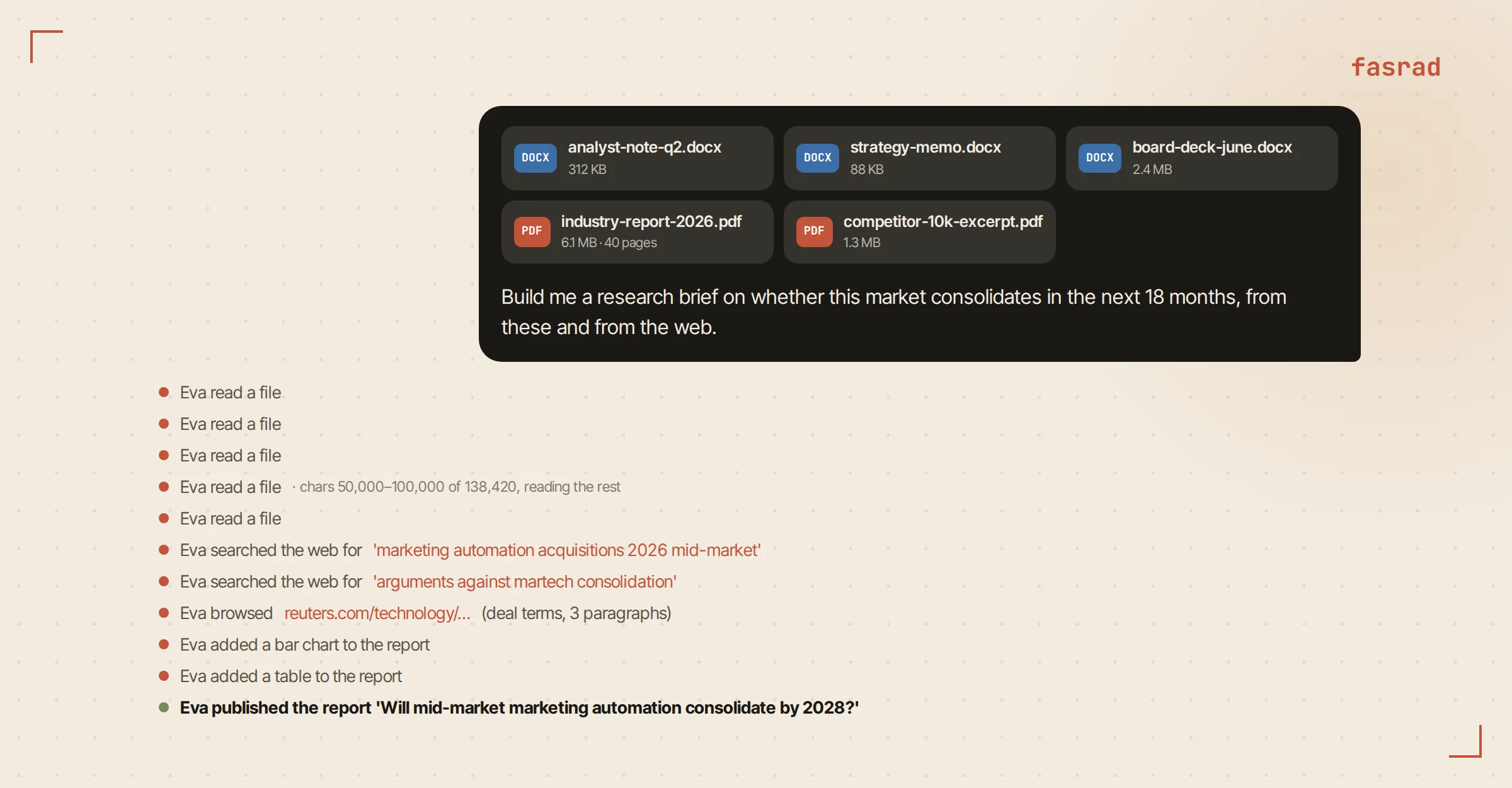
Owen's question was whether his market, mid-market marketing automation, would consolidate in the next eighteen months. He had the raw material and no time to read it. He dragged three Word documents and two PDFs into the chat, an analyst note, an internal strategy memo, a board deck exported to DOCX, a 40-page industry report, and the excerpt from a competitor's 10-K, and five chips lined up over the composer. Then he typed "Build me a research brief on whether this market consolidates in the next 18 months, from these and from the web."
The agent reads each file itself. Word documents come through as paragraphs and tables, PDFs as text, with OCR for a scanned page. A long file arrives in pages of 50,000 characters and the agent keeps reading until it has the whole thing, so the 40-page report is read, not sampled. Then it goes to the web for what the files cannot hold: recent deals, current numbers, and the counterpoints an internal memo tends to skip. A search result is only a lead. The agent opens the pages that matter and reads them too.
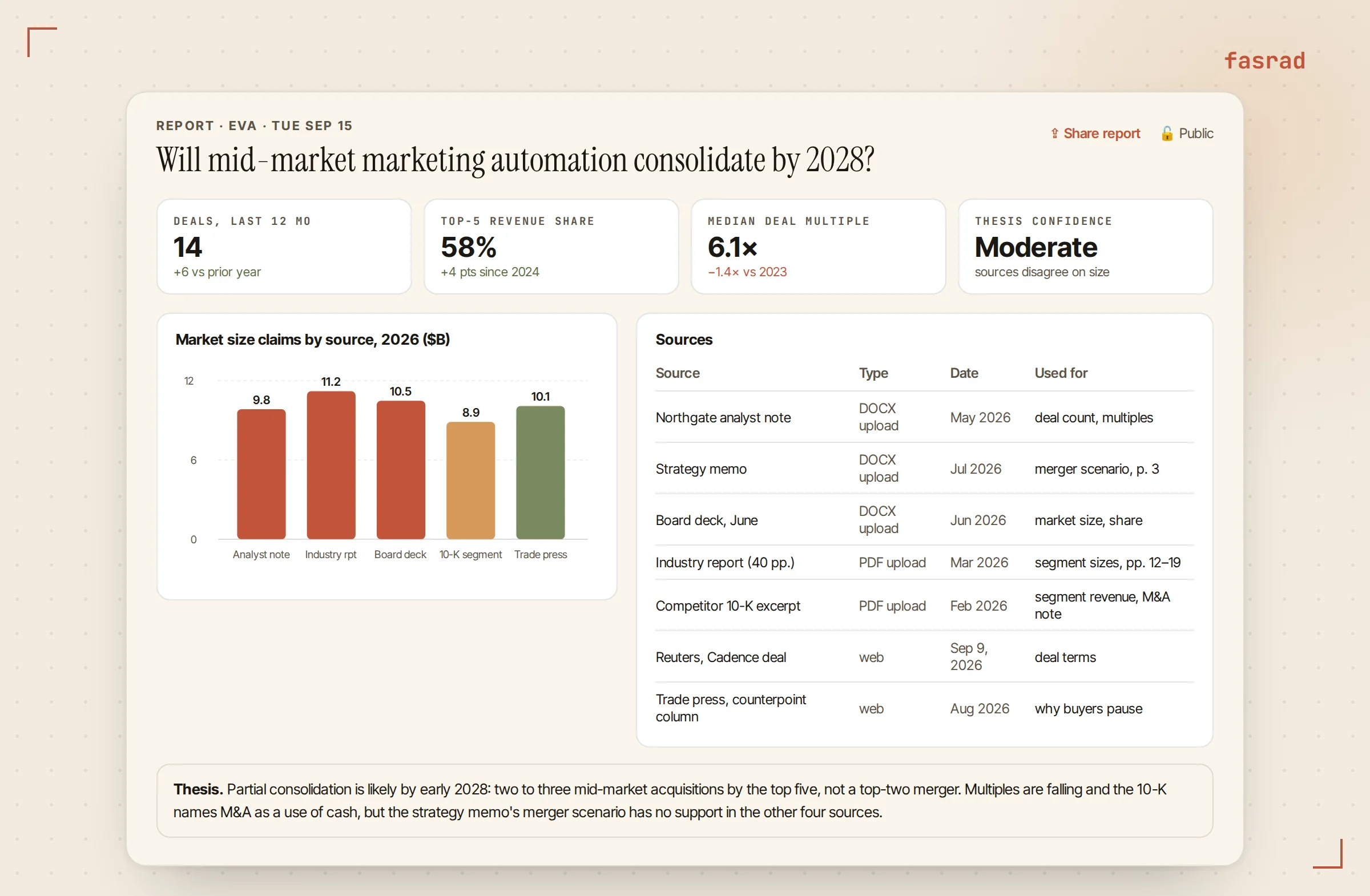
Fifteen minutes later the brief arrived as a report card in the chat: a thesis section, a metric row, the market-size claims from each source as a bar chart, a section on recent deals, and a sources table naming every document and web page it drew on. Share report copies a link. The report is public by that link until he switches it to private with one click on the card. An AI research analyst built this way reads your files first and the web second, and it shows its sources either way.
Tuesday evening: pressing on the weak points
He read it on the couch and pushed back. "The strategy memo assumes the top two players merge. What in the other sources supports or contradicts that?" The agent answers from the files it read that afternoon and names the page it is quoting. Nothing gets re-uploaded. The files stay with the conversation.
"Find the two strongest arguments that this market does not consolidate." That one goes back to the web, and the reply cites what it found rather than paraphrasing a snippet. By ten he had a thesis he believed and two objections he could name, which is the position a market research agent is for.
Wednesday morning: "include this article"
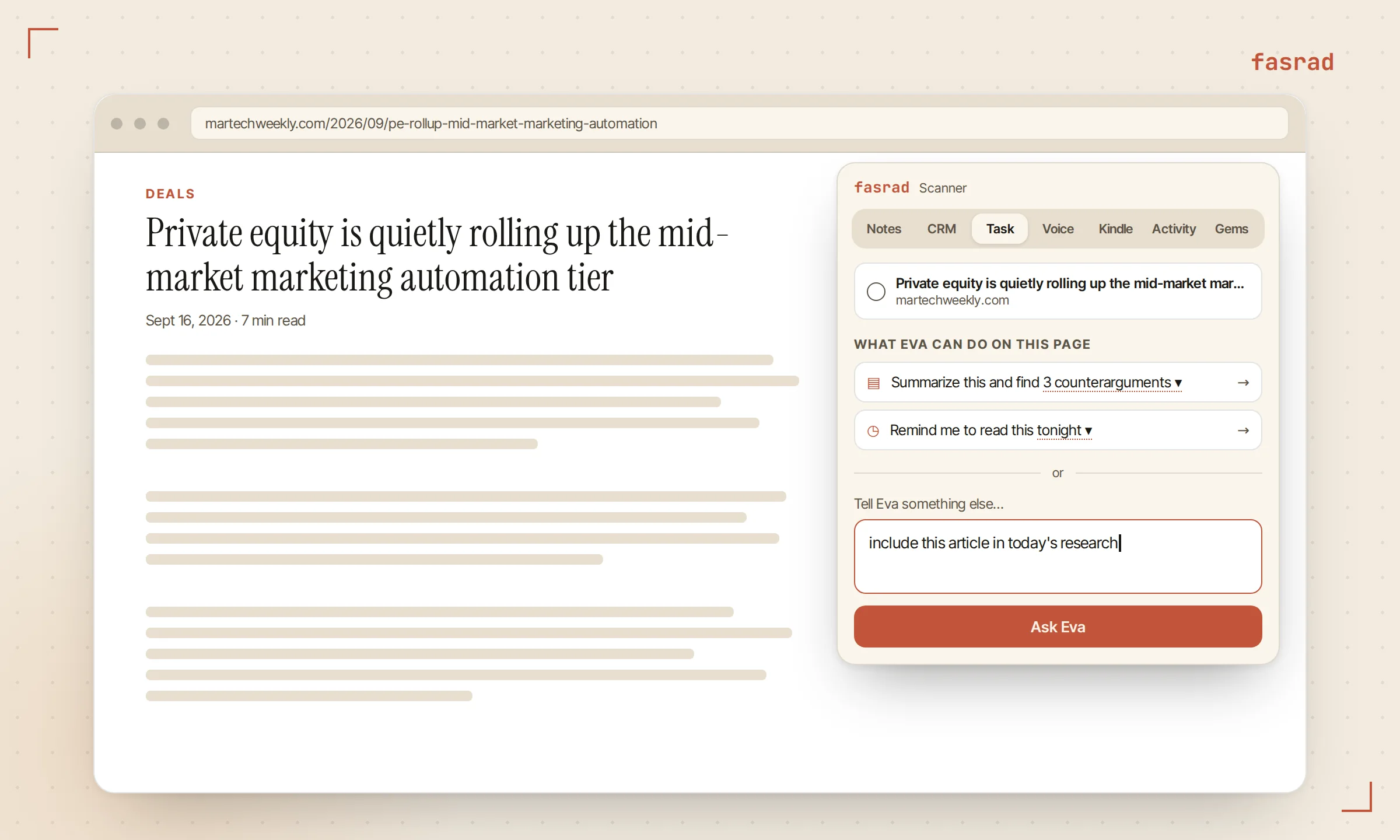
Reading a trade publication in Chrome, he hit a piece on a private-equity roll-up in the adjacent tier. He opened the Scanner extension, switched to the Task tab, and typed "include this article in today's research" into the box under the page title. The agent proposes what it will do in one sentence, as a research task. He can edit that sentence, then confirm.
On confirm, the extension captures the article from his own tab, so a paywall or cookie wall his browser already passed does not stop the agent, and the full text travels with the task rather than an excerpt. The task ran within seconds and replied in the chat: what the article adds, and which section of the brief it touches. "Fold that into the brief and republish, with the article in the sources table" produced a revised report as a new card with its own link. Tuesday's link keeps working.
Wednesday afternoon: the one-page PDF
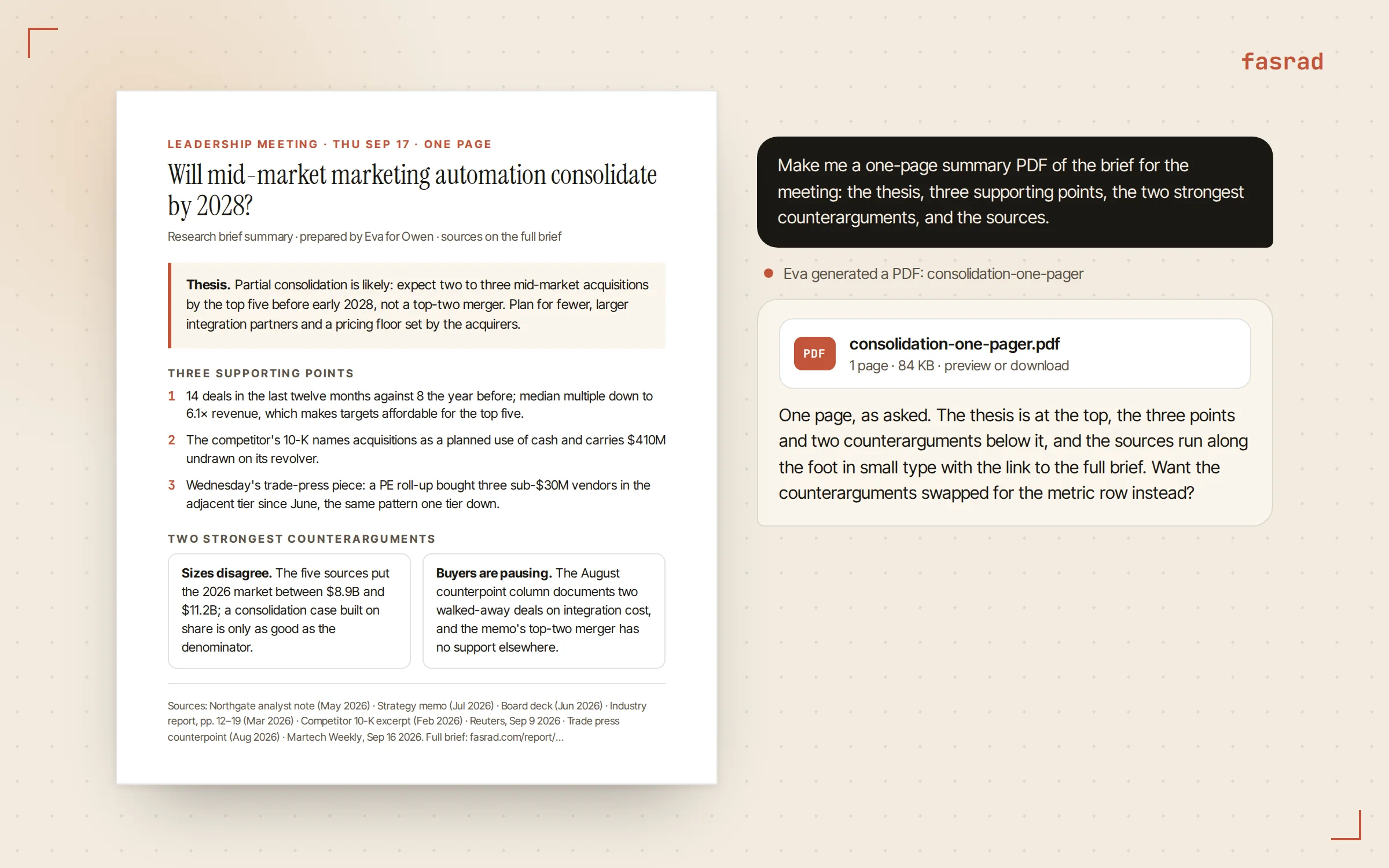
A leadership meeting gets a page, not a report. "Make me a one-page summary PDF of the brief for the meeting: the thesis, three supporting points, the two strongest counterarguments, and the sources." The agent writes the page as HTML with its own styling, compiles it to PDF, and posts the file in the chat as a chip he can preview or download.
Because the layout is written as HTML, the agent controls the page: a single sheet, the thesis in a pull-out, a two-column block for the counterarguments, sources in small type at the foot with the link to the full brief. PDF creation is a skill on the agent's Skills tab, on by default. The same skill converts Word, PowerPoint, and Excel files to PDF, so the board deck itself can go out as one if that is what the room needs. A document reviewer uses the same reading, and a due diligence agent the same brief-then-summary shape.
Thursday 8 AM: the brief comes back on its own
Owen's morning briefing arrives at 8, the time he set. It looks at the calendar for the next two days and brings back earlier work that matches what is coming up, with its age attached, so Wednesday's article task appears beside the 10 AM leadership meeting instead of disappearing into the scroll. Forty-five minutes before the meeting, because the invite carries attendees, a short pre-meeting brief lands with a section headed earlier work on this.
The full report and the PDF sit in the chat thread and on the Work page, where every report the agent has published is listed. He had the link, the page, and the two objections ready. Two days, five documents, one article, and the meeting went the way meetings go when one person has read everything.
Frequently asked questions
What file types can I upload for a research brief?
PDF, Word (.doc and .docx), PowerPoint, Excel, plain text, CSV, and images, up to 200 MB per file, and several files in one message. The agent reads Word paragraphs and tables and PDF text, with OCR for scanned pages.
Does the agent read the whole document or only the first pages?
The whole document. Long files are read in pages of 50,000 characters and the agent continues from where the previous page ended until it has everything, so a 40-page report is read in full.
Can I share the brief with people who do not use Fasrad?
Yes. Every published report has a link, copied with one click on the card, that opens the report as its own page. The card also has a public or private switch, so you decide who can open the link.
How do I add an article I am reading to the research?
Open the Scanner extension on the page, go to the Task tab, and type what you want done in the box. The agent shows its reading of the request as one sentence, you confirm, and the extension sends the page from your own tab so paywalled or cookie-walled articles work too. The result comes back in the chat.
Do I need to enable anything to get a PDF?
PDF creation is a skill in the agent's Skills tab and it is on by default. The agent writes the page as HTML and compiles it to PDF, which is how it controls a one-page layout. It also converts Word, PowerPoint, and Excel files to PDF.
Will the agent bring the brief back before my meeting?
The morning briefing looks at the next two days of your calendar and brings back earlier work that matches, with its age stated. If the meeting invite has attendees or names one of your contacts, a pre-meeting brief arrives about 45 minutes before it starts with an earlier-work section. Reports are also listed on the Work page.
Can the brief be updated later?
Yes. Ask for the change in the chat and the agent publishes a revised report as a new card with its own link. Earlier versions keep their links, so anyone you already sent one to still has it.