A Fasrad agent monitors a web page by taking a snapshot of it, fetching it again on a daily or weekly schedule, and messaging you only when what changed actually matters. You describe the page in one sentence in the chat, the agent confirms it can reach it without a login, and from then on price edits, new announcements and status changes reach you as a message that leads with the change and links the page.
How to monitor a web page with an AI agent
Point the agent at a public page, pick daily or weekly, and get one message when the price, the status or the announcement actually changes. Nothing for banners and timestamps.
Fasrad · September 17, 2026 · 5 min read
Jess is a developer in Denver who ships a product on top of a third-party messaging API. Last spring the vendor raised its overage rate, and she found out a week later from a forum thread, after the new rate had already landed on her bill. She now has her agent watch the vendor's pricing page, its status page, and a competitor's pricing page, and she has not been surprised since.
Step 1: Tell the agent what to watch
Type the URL and the request. Jess wrote "Watch https://developer.wavecast.io/pricing and tell me when it changes." That was the whole setup. The agent creates the monitor with a daily check by default; add "weekly" to the sentence if once a week is enough.
Before anything is saved, the agent loads the page once, without cookies or a login, and keeps that copy as the baseline. That first fetch is also the reachability test. If the URL redirects to a sign-in page, lands somewhere else, or comes back nearly empty, the agent tells you the page needs a login and that monitors can only watch publicly reachable pages. A public pricing page passes.
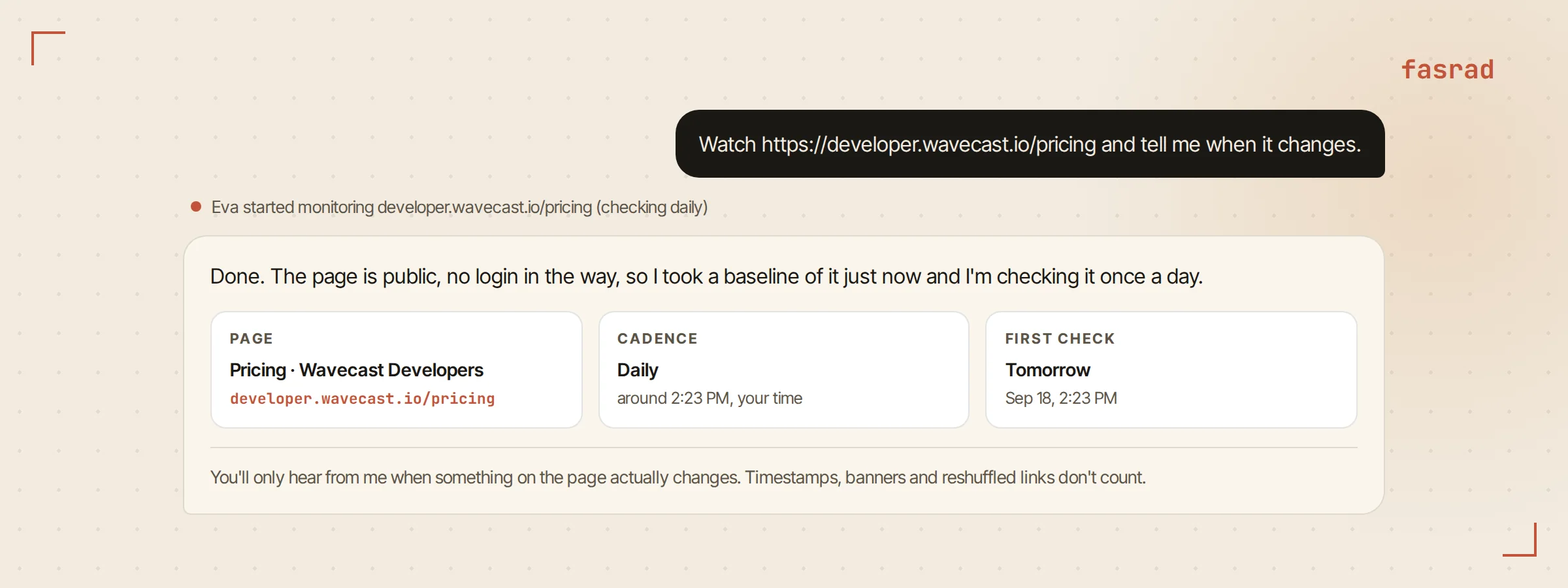
The confirmation names the cadence and the first check. The first check runs one full period after the baseline, so a daily monitor checks tomorrow and a weekly one checks in seven days. Each monitor gets its own minute of the day, so the check lands at the same time every day for that page. This is the setup a developer agent uses for every vendor a codebase depends on.
Step 2: Understand what counts as a change
Every check fetches the page fresh, strips clock times, dates and whitespace, and compares the text to the last snapshot. Identical text ends the check there. Small drift under a fixed floor is treated as noise too, so a swapped ad slot never wakes you. Silence is not permanent, though: drift is measured against the same baseline, so a slow accumulation of edits still gets looked at once it grows large enough.
A bigger difference goes to a classifier that reads only the changed regions of the page, with a few words of context around each one. Pricing, availability, announcements, new versions, added or removed features, new posts and status changes count as material. Timestamps, cookie banners, visit counters, reshuffled navigation and social-proof widgets count as cosmetic. A cosmetic verdict quietly becomes the new baseline, so the same reshuffle is never judged twice.
The classifier's job is not a yes or no. It has to describe what changed, before versus now, naming the values it sees, and it may cover up to three distinct changes in one summary. If it cannot describe the change, nothing is sent and the next check tries again.
Step 3: Read the change when it arrives
A material change arrives as a normal message from the agent, in the chat, or on Telegram if that is where the agent reaches you. It opens with the change itself. Bold line, then the numbers. No preamble, no status report, and no tool calls: the summary was extracted during the check, so the agent's only job is to phrase it and link the page.
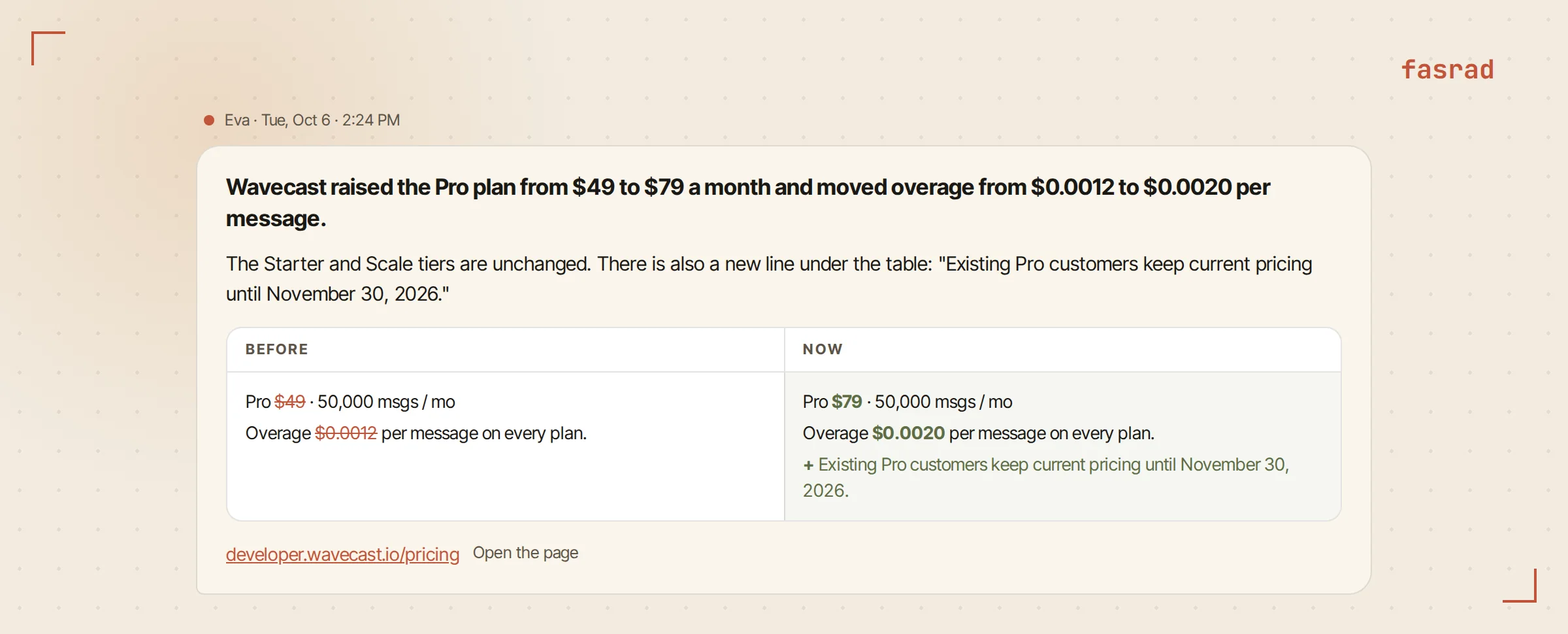
For Jess the message read, in bold, that the Pro plan had moved from $49 to $79 a month, with the old and new overage rates underneath and the page linked. She opened the page, checked the grandfathering line, and had the budget conversation the same afternoon rather than after the invoice. The same shape works for a competitive intelligence agent watching a rival's plans page.
Step 4: Add pages from the browser
The second and third monitors did not go through the chat at all. Jess installed the Scanner extension for Chrome and Firefox, opened the competitor's pricing page, and clicked the Task tab. Under "What Eva can do on this page" the first suggestion was "Monitor this page for changes, check daily", with the cadence as a dropdown offering daily or weekly.
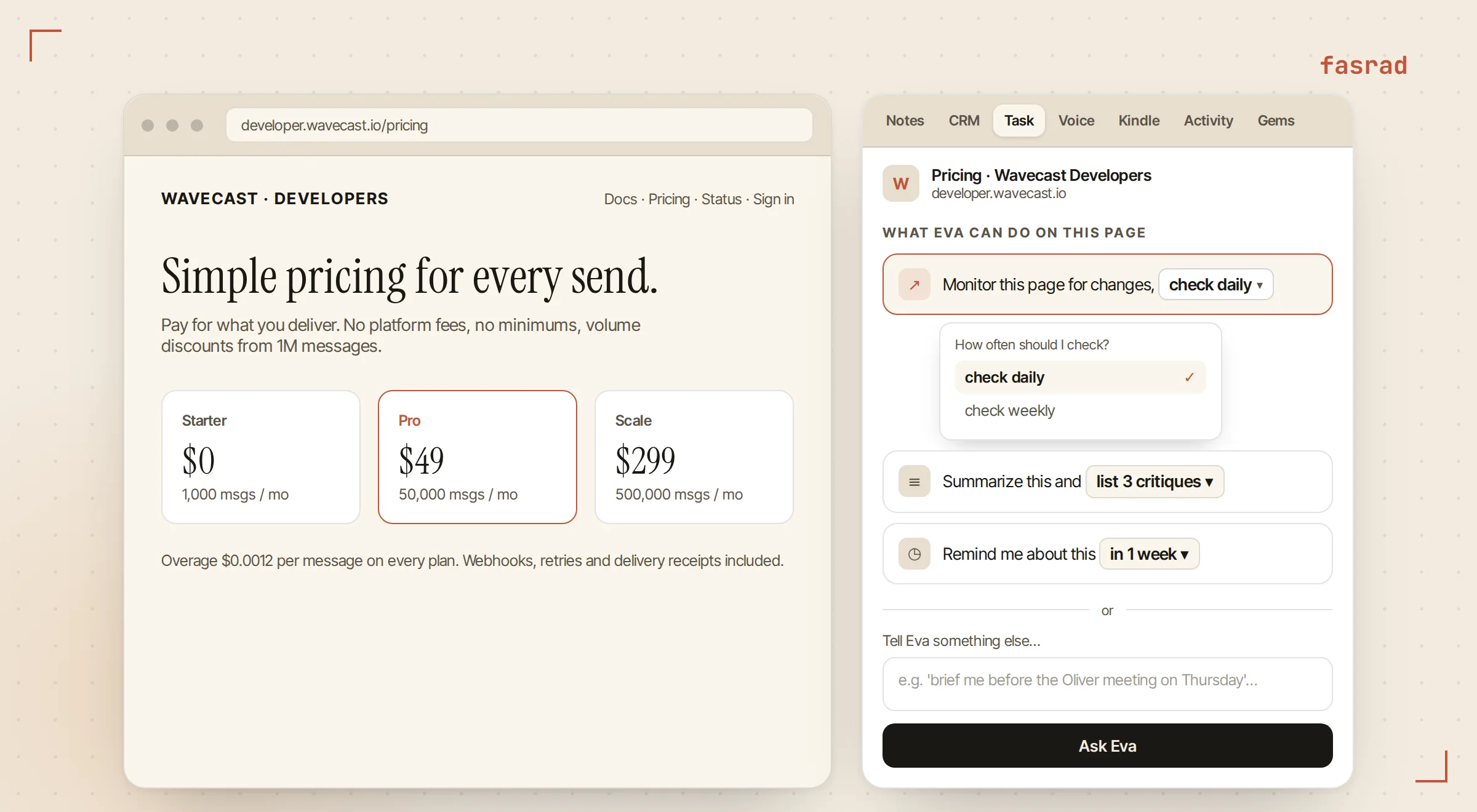
One click, same monitor. It is created the way the chat creates it, with the same public-page check and the same baseline. She switched the competitor to weekly, because their prices move slowly, and left the vendor's status page on daily. The suggestion does not appear on social feeds, where a page changes on every load and monitoring would mean nothing.
Step 5: Ask what it is watching
"What are you watching for me?" gets a list back: each page, its cadence, and when the next check runs. The same list lives on the Work page under its schedules, where every monitor is a card titled with the page name, its repeat rule, its next run, and how many runs it has done so far. A run that found a change keeps its message on the card; a run that found nothing says so.
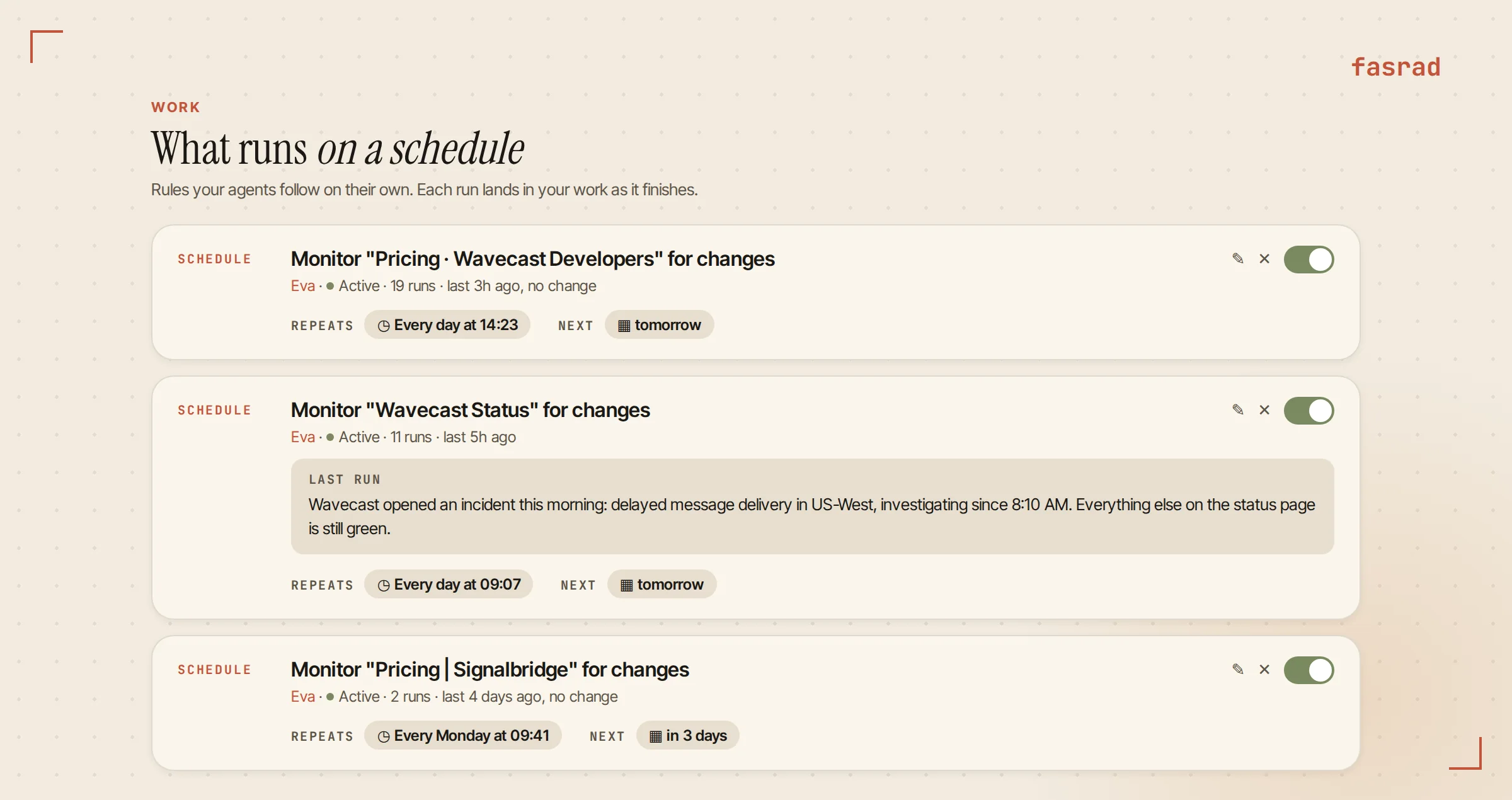
Each card has a pause toggle, and the changes a monitor found also show up in the Work feed under Monitors, so the history of a page is in one place. A brand monitoring agent runs on exactly this, pointed at press pages and reseller listings instead of an API vendor.
Step 6: Cancel a monitor when the project ends
When Jess moved off the competitor's platform for good, she typed "Stop watching the Signalbridge pricing page." The agent matches the page by URL or by its number from the list and ends it. The snapshots stay. An old change can still be found, but nothing fetches the page again. Pausing from the Work page does the same thing temporarily.
Up to fifty monitors run per account, and a page can only be watched once. A compliance monitor built this way watches a handful of regulator pages the same way Jess watches her vendor: one sentence to start, one message when something real changes, one sentence to stop.
Frequently asked questions
How often does the agent check a page?
Daily or weekly. Each monitor gets a fixed time of day, so a daily monitor checks at the same time every day and a weekly one on the same weekday. The first check runs one full period after the baseline.
Can it watch a page behind a login?
No. Monitors fetch the page without cookies, so a page that redirects to a sign-in screen or comes back almost empty is refused when you create it. The agent tells you the page needs a login, and only publicly reachable pages are watched.
Will I get a message every time the page changes at all?
No. Identical text and tiny drift end the check silently. Larger differences are judged by a classifier that treats prices, availability, announcements, new content and status changes as material and treats timestamps, banners, ad slots and navigation reshuffles as cosmetic. Only material changes become a message.
What does the change message look like?
It leads with what changed, before versus now, naming the values the agent saw, and it links the page. If several things changed it covers up to three, most important first. There is no preamble and no status report.
Where can I see all my monitors?
Ask the agent what it is watching for you, or open the Work page and its schedules. Each monitor is a card with the page name, the repeat rule, the next check, the run count and the last change it found. Changes also appear in the Work feed under Monitors.
Can I add a monitor without opening the chat?
Yes. With the Scanner browser extension open on the page, the Task tab suggests Monitor this page for changes with a daily or weekly cadence. One click creates the monitor with the same public-page check the chat uses.
How do I stop one?
Tell the agent to stop watching the page, by URL or by its number from the list, or pause it from its card on the Work page. Up to fifty monitors can run per account, and the same page cannot be watched twice.