A Fasrad agent keeps track of your purchases by reading the order confirmations that already land in your mailbox. You connect the mailbox read-only, tell the agent once that every order belongs in a table, and from then on each confirmation, shipping notice, and return becomes a row or a status change. Marcus, in Columbus, Ohio, set it up in one sentence when his household's orders started arriving faster than anyone could remember them.
Keep track of your purchases with an AI assistant
Every order confirmation, from Amazon to the pharmacy to the airline, becomes a row in one table. Ask what is arriving this week, what last month cost, and whether the coffee filters ever shipped.
Fasrad · September 17, 2026 · 5 min read
Connect the mailbox first
The agent watches your own mailbox over IMAP. You give it the address and an app password, which works for Gmail, Google Workspace, and any provider with IMAP access, and the connection is read-only from the start: the agent never marks a message as read, never moves or deletes anything, and your mail client keeps behaving exactly as before. Watching is forward-only too. Mail that arrived before the connection is never touched, so the table starts with the next confirmation, not with a backlog of old receipts.
Marcus's family uses one shared address for shopping, which makes it the natural thing to watch. An AI agent with its own email inbox can also hold a separate account, but for purchases the mailbox the stores already write to is the one that matters. Gmail users get the same setup through an AI agent for Gmail.
The rule you set once
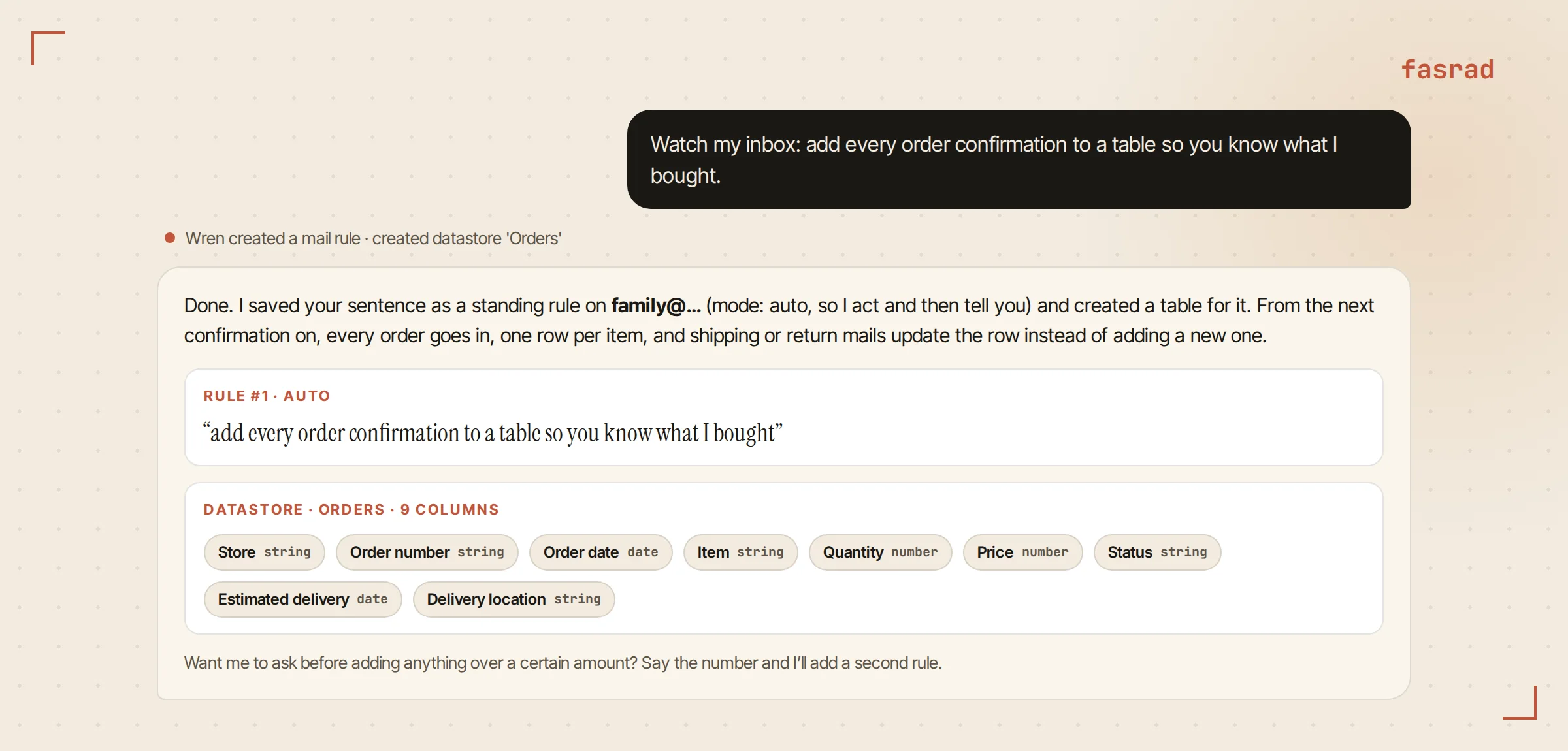
Marcus typed "Watch my inbox: add every order confirmation to a table so you know what I bought." The agent stored that sentence, word for word, as a standing mailbox rule, created a datastore called Orders with the columns it needs, and confirmed both in one reply. Standing rules live beside the agent's other memories and are never paraphrased, so the rule that fires next month is the one he wrote.
Rules have two modes. Auto acts and then tells you what it did, ask-first describes what arrived and waits for your yes. Marcus kept orders on auto and added a second rule for anything over $300 to ask first. Changing a rule is a sentence in chat, and "what rules do you have?" lists them.
What the table holds
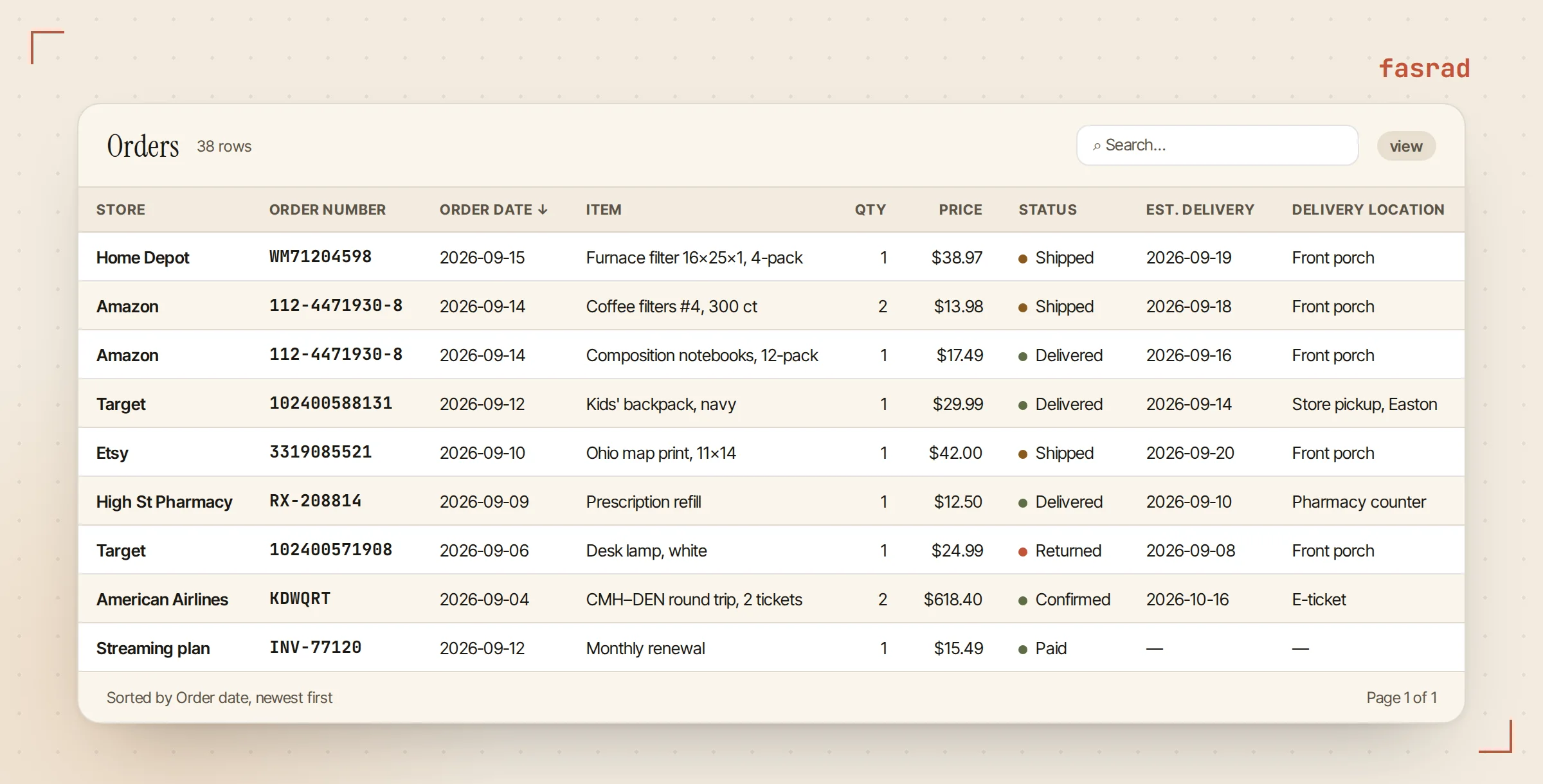
The Orders datastore has typed columns: store, order number, order date, item, quantity, price, status, estimated delivery, and delivery location. Dates are dates and prices are numbers, which is what makes sums and date ranges work later. Every store writes to the same table. A Target pickup, a Home Depot delivery, an Etsy print, a refill from the pharmacy on High Street, two airline tickets, and the streaming subscription that renews on the 12th all land as rows with the same nine columns, and the store column tells them apart.
One order becomes one row per item. Three things in a single Amazon box are three rows sharing an order number, so a question about the coffee filters gets an answer about the coffee filters. The agent inserts with the order number and item as the row's identity, and a second mail about the same order updates the existing row instead of adding a copy. When Marcus asks to see the table it appears in the chat as a live widget, sortable by any column, with a search box, and in edit mode he can fix a price or delete a row by hand. Ask for a CSV, an Excel file, or a Google Sheet and the whole table exports.
Questions you can ask
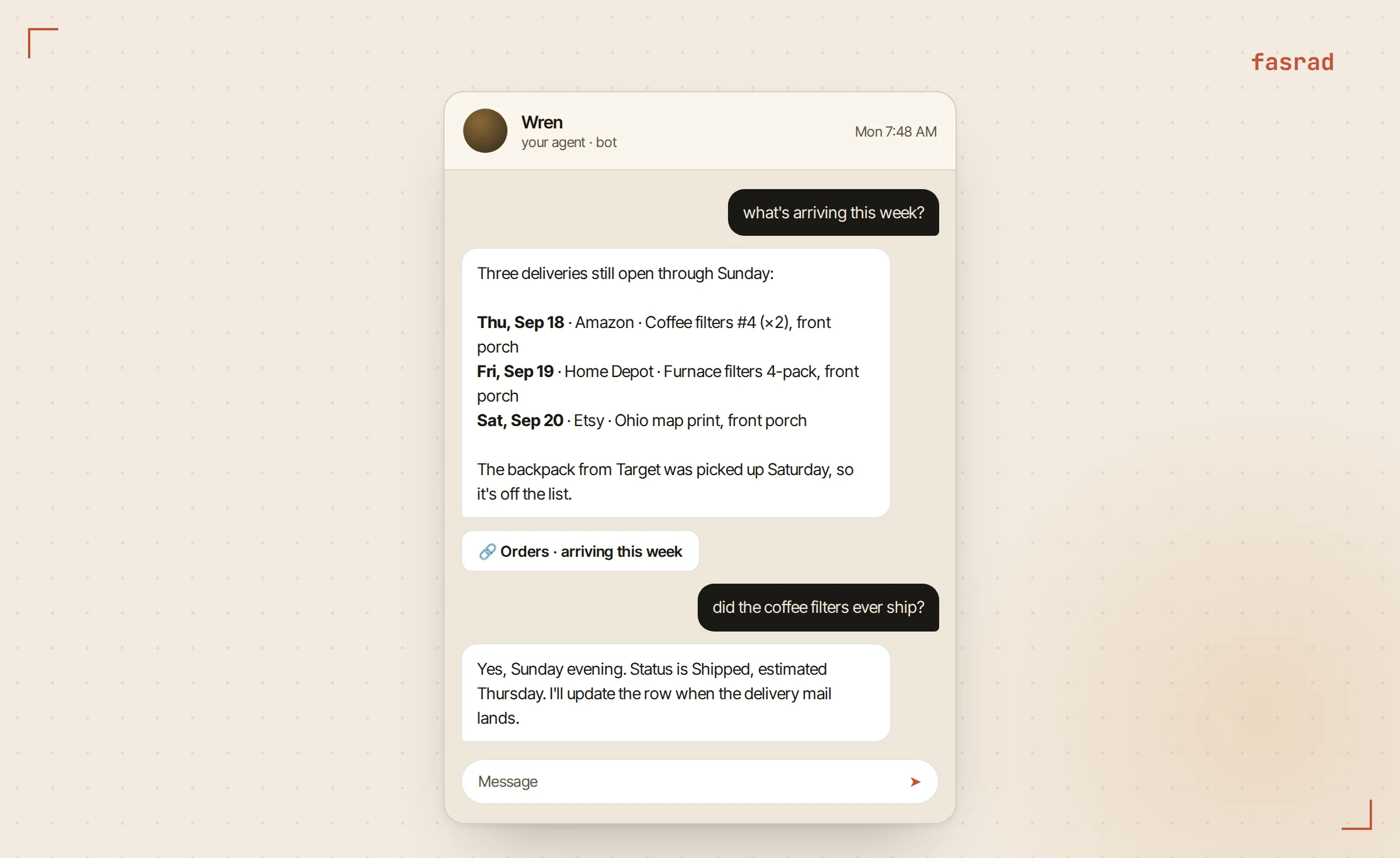
The table is only useful if the answers come out in plain English. "What's arriving this week?" filters on the estimated delivery column and returns the open rows for the next seven days. "How much did we spend on the kids' school stuff last month?" is a search across the items plus a sum on the price column, scoped to August, and the agent shows the rows it added up so the total can be checked. "Did the coffee filters ever ship?" is a search for one item, answered with its status and the date of the last update.
The same table also answers slower questions. "Which store did we order from most this year?" groups the rows by store. "Show me everything still marked Shipped that was due before today" finds the packages worth chasing. This is the purchase side of an AI expense tracker; a budget agent built on the same data can compare the monthly total against a limit you set.
Same answers on Telegram
Marcus asks most of these from his phone. The agent on Telegram is the same agent with the same table, so "what's arriving this week?" typed into the Telegram chat comes back as three short lines. When the answer is a table or a chart, Telegram gets a button that opens it in place. A Telegram AI assistant is the same setup with the phone as the main screen.
When things change: returns, refunds, delivery updates
Stores send several mails per order: the confirmation, the shipping notice, sometimes a delay, sometimes a return label and a refund. Each one passes the same rule. The agent reads the full message, finds the row by order number and item, and changes the status column to Shipped, Delivered, Returned, or Refunded, updating the estimated delivery date when the carrier moves it. Nothing is added twice.
Not every change is worth a message. When an update only touches a detail you already have, the agent updates the row and stays quiet. It speaks up for what you would want to hear: a delivery pushed to next week, a cancellation, a refund that came in smaller than the price paid. A rule set to ask-first turns those moments into a question with buttons instead of a done deed. Mail that arrives overnight waits until morning unless it is urgent.
Monthly spend in a report card
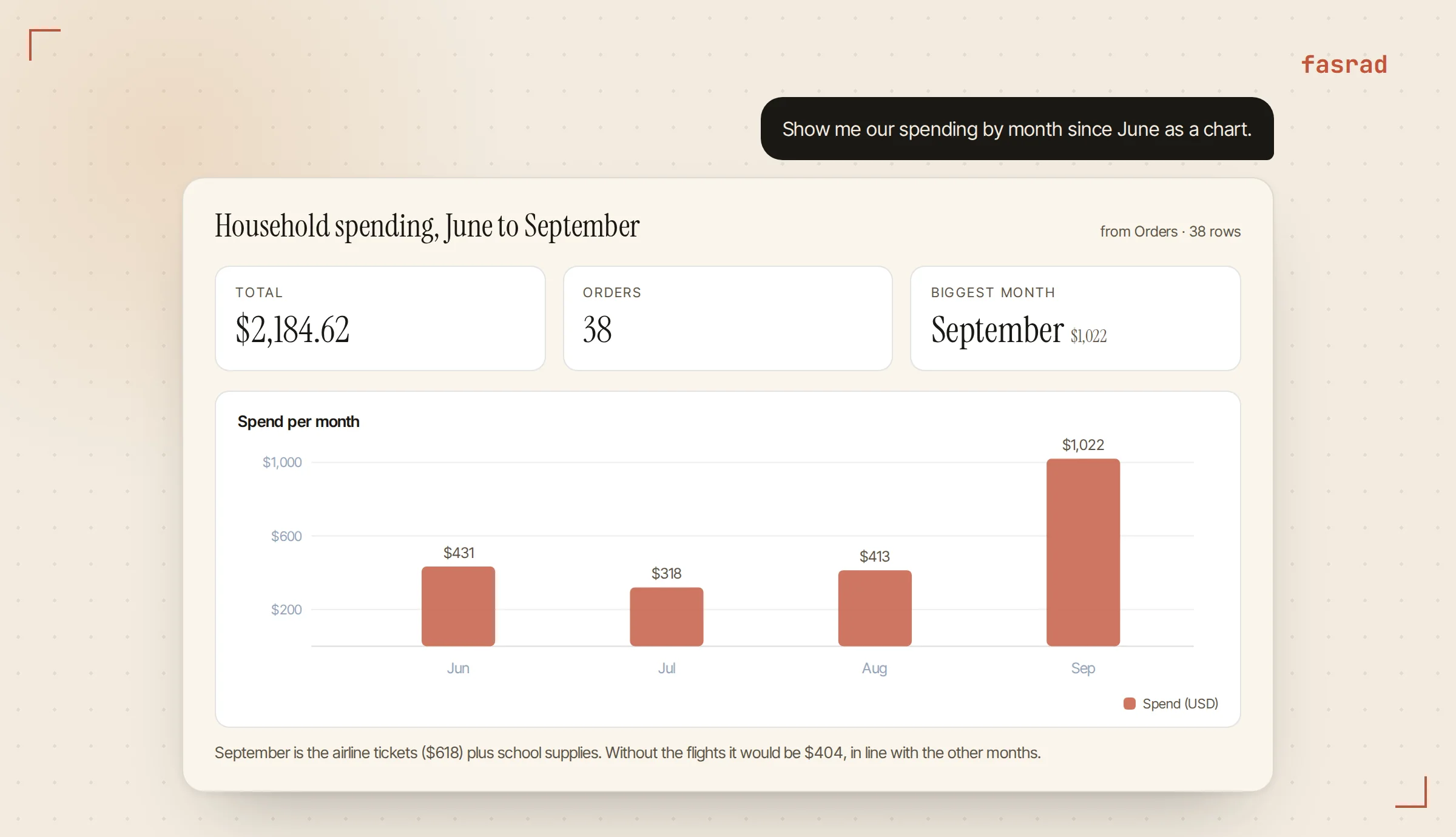
For the bigger picture Marcus asks "Show me our spending by month since June as a chart." The agent sums the price column per month, builds a report with a metric row and a bar chart, and publishes it as a card in the chat. On Telegram the same request returns a button that opens the report. The chart is drawn from the table at that moment, so re-asking next month gives a fresh one. An AI personal assistant that already reads the mailbox for bookings and appointments does this with the same rule mechanism, one sentence per kind of mail.
Frequently asked questions
Which mailboxes can the agent watch?
Any mailbox with IMAP access, including Gmail and Google Workspace with an app password, Outlook and other providers with IMAP, and mailboxes from your own domain. The connection is read-only: the agent never marks mail as read, moves it, or deletes it.
Does it only work for Amazon orders?
No. The rule matches every order confirmation regardless of sender, so Target, Home Depot, Etsy, a pharmacy, an airline, and a subscription renewal all land in the same table with the same columns. Amazon is one store among many.
What about orders from before I connected the mailbox?
Watching is forward-only, so old mail is never processed on its own. If you want history, ask the agent to search the mailbox for past confirmations and add them; it searches your mail live and inserts the rows it finds, skipping any order number already in the table.
Will a shipping notice create a second row?
No. The order number and the item identify a row, so a shipping notice, delay, or return for the same order updates the existing row's status and dates instead of adding a copy.
Can I fix a row by hand?
Yes. Ask for the table in edit mode and change any cell, add a row for a cash purchase, or delete one. You can also just tell the agent what to change and it updates the row for you.
Can I get the table out of Fasrad?
Yes. Ask for a CSV, an Excel file, a PDF, or a Google Sheet and the agent exports the whole table, or the filtered part of it you asked for.
Is the content of my mail safe with the agent?
The agent treats mail as untrusted input: it extracts facts like order numbers and prices and never follows instructions found inside a message. Mail that looks like a manipulation attempt is held and reported to you instead of being processed.